Spotted Eagle Rayマダラトビエイ
Aetobatus narinariEN— Endangered
The spotted eagle ray is a striking, white-spotted ray found in tropical and subtropical seas worldwide, known for its long tail, duck-like snout used to dig up buried shellfish, and its habit of leaping clear of the water.
Operating facilities registered on this site: Japan 2 (Osaka Aquarium Kaiyukan, Niigata City Aquarium). These facilities are confirmed by resident animal records or the facility’s official information.
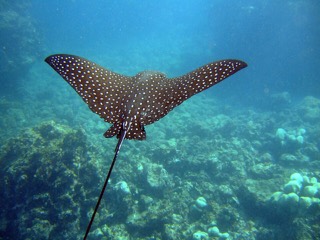 Spotted Eagle Ray (reference photo)

Species Data
- Classification
- Myliobatiformes / Aetobatidae Source
- Size
- Large individuals have a disc width of around 3 m and a total length including the tail of up to 5 m
- Weight
- About 230 kg for large individuals
- Diet
- Carnivore Preys mainly on benthic invertebrates such as bivalves, snails, and crabs, crushing hard shells with its chevron-shaped tooth plates
- Distribution
- Found in tropical and warm temperate waters worldwide, inhabiting shallow coastal areas near coral reefs and bays down to about 80 m depth, favoring water temperatures of 24-27°C. Source
- Sources
- en.wikipedia.org
Did You Know?
Where to See This Species
Operating facilities registered on this site: Japan 2
Osaka Aquarium KaiyukanOsakaOpened in 1990
Niigata City AquariumNiigataOpened in 1990
Possible records, not yet confirmed: 4
These facilities are not confirmed by an official animal list. They appear in secondary sources such as Wikipedia; check the facility’s official website for current exhibits.
Kagoshima City AquariumKagoshimaFrom Kagoshima-Chuo Station, take the tram (Route 2) to the Suizokukan-guchi stop and walk 8 minutes.
(Not confirmed by official sources) Source
Miyajima Public AquariumHiroshimaOpened in 2011
(Not confirmed by official sources) Source
Kyoto AquariumKyotoAbout a 15-minute walk from the central exit of JR Kyoto Station.
(Not confirmed by official sources) Source
Shimane Aquarium AQUASShimaneAbout 12 minutes on foot from JR Hashi Station (2 hours 23 minutes from JR Matsue Station to JR Hashi Station; 1 hour 24 minutes from JR Masuda Station).
(Not confirmed by official sources) Source
Conservation Story
Conservation Status
Endangered (EN)
Sources
Support Conservation
A visit is a small, positive way to support the daily lives of the animals you care about.
- Visit
- A visit itself helps support the facility.
- Animal Supporter Programs & Giving
- Find ways to support the facility through its official website.
- Furusato Nozei
- Municipally run facilities may share official guidance for this Japanese hometown-tax program.
FAQ
- Where can I see Spotted Eagle Ray in Japan?
- Operating facilities registered on this site: Japan 2 (Osaka Aquarium Kaiyukan, Niigata City Aquarium). These facilities are confirmed by resident animal records or the facility’s official information. Source
- How large can a spotted eagle ray grow?
- Large individuals can reach a wingspan of around 3 m, a total length (including tail) of up to 5 m, and weigh about 230 kg. Source
- What does a spotted eagle ray eat?
- It feeds mainly on bivalves, crabs, whelks, and other mollusks, using chevron-shaped tooth plates to crush hard shells. Source
- Why does the spotted eagle ray jump out of the water?
- The exact reason isn't fully understood, but leaping is commonly observed; rays have even landed in boats on at least two documented occasions. Source
Books & gear
Source: ja.wikipedia.org en.wikipedia.org