Whale Sharkジンベエザメ
Rhincodon typusEN— Endangered
The whale shark is the world's largest fish, a gentle filter-feeding giant that migrates through tropical and warm-temperate seas worldwide, drawing divers and, unfortunately, fishing pressure that has driven steep population declines.
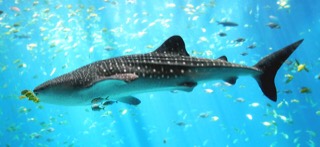 Whale Shark (reference photo)

Species Data
- Classification
- Orectolobiformes / Rhincodontidae Source
- Size
- Said to reach a maximum total length of 20 m; the most reliable record is a female of about 18.8 m that stranded in the Arabian Sea in 2001
- Lifespan
- Matures at about 30 years and is thought to live 60–70 years; some suggest a lifespan of 150 years
- Diet
- Filter feeder Filter feeder that consumes small crustaceans such as krill and their larvae, cephalopod larvae, small fish, and seaweed
- Distribution
- Migrates through tropical, subtropical, and warm temperate surface waters worldwide within about 30 degrees of the equator; in Japanese waters it appears from early summer through autumn. Source
- Sources
- ja.wikipedia.org en.wikipedia.org
Did You Know?
- Schools of sardines, tuna, and other fish often gather around whale sharks, which is why fishing communities in Japan have long regarded their presence as a sign of a good catch. Source
- Whale sharks spend about 95% of their time in the sunlit zone shallower than 200 m, but regularly dive below 500 m during the day into evening. Source
Where to See This Species
Operating facilities registered on this site: Japan 5
Okinawa Churaumi AquariumOkinawaOpened in 2002
Osaka Aquarium KaiyukanOsakaOpened in 1990
Aqua World Ibaraki Prefecture Oarai AquariumIbarakiAddress: 8252-3 Isohama-cho, Oarai-machi, Higashiibaraki-gun, Ibaraki Prefecture.
Kagoshima City AquariumKagoshimaFrom Kagoshima-Chuo Station, take the tram (Route 2) to the Suizokukan-guchi stop and walk 8 minutes.
NOTOJIMA AQUARIUMIshikawaThe nearest station is Wakura-Onsen Station.
Conservation Story
Conservation Status
Endangered (EN)
Sources
Support Conservation
A visit is a small, positive way to support the daily lives of the animals you care about.
- Visit
- A visit itself helps support the facility.
- Animal Supporter Programs & Giving
- Find ways to support the facility through its official website.
- Furusato Nozei
- Municipally run facilities may share official guidance for this Japanese hometown-tax program.
FAQ
- Is the whale shark dangerous to humans?
- No. Despite its enormous size, it is a filter feeder that eats plankton, krill, and small fish, posing no threat to swimmers or divers. Source
- How long do whale sharks live?
- They are estimated to mature around age 30 and can live 60-70 years, with some researchers suggesting a maximum lifespan of up to 150 years. Source
- Why are whale sharks endangered?
- Global numbers have declined by roughly 50% over the past 75 years, driven mainly by targeted fishing, bycatch, and vessel strikes, leading to an Endangered IUCN listing. Source
- How many operating facilities are registered here?
- Operating facilities registered on this site: Japan 5 Source
Books & gear
Source: churaumi.okinawa churaumi.okinawa www.kaiyukan.com www.kaiyukan.com iucn.org