American Bisonアメリカバイソン
Bison bisonNT— Near Threatened
The American bison is the largest land mammal in North America, once numbering in the tens of millions across a range stretching from Alaska to the Gulf of Mexico. Nineteenth-century mass slaughter reduced the population to a few hundred animals, but conservation efforts have since rebuilt wild herds to roughly 31,000, and the species is now classified as Near Threatened by the IUCN. It remains an ecological keystone species, shaping the grasslands it grazes.
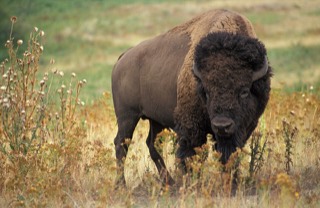 American Bison (reference photo)

Species Data
- Classification
- Artiodactyla / Bovidae Source
- Size
- Head-body length up to about 3.5 m in males and about 2.85 m in females; height up to about 186–201 cm in males
- Weight
- Males about 730–1,270 kg; females smaller (overall range about 318–1,179 kg)
- Lifespan
- Wild: about 15 years; captive: up to about 25 years
- Diet
- Herbivore Herbivorous grazer, feeding mainly on grasses and also on sagebrush and similar plants in harsh periods
- Activity
- Moves in herds, alternating between feeding, resting, and ruminating roughly every 2 hours
- Distribution
- American bison once ranged across a vast 'bison belt' from Alaska to northern Mexico and the Atlantic seaboard. Today they survive in national parks such as Yellowstone and Wood Buffalo, on conservation herds and ranches across North America, and in reintroduced populations in Russia's Yakutia region. Source
- Sources
- ja.wikipedia.org en.wikipedia.org
Did You Know?
- Mass slaughter during the 1870s drove the population from an estimated 60 million down to just a few hundred animals, pushing the species to the brink of extinction. Source
- Despite their bulk, bison can run 65 to 70 km/h (40–45 mph), and at Yellowstone National Park they injured more visitors than bears did between 1980 and 1999. Source
- The wild population, reduced to about 541 animals by 1889, has recovered to roughly 31,000 by 2019 thanks to conservation efforts, though many herds carry cattle DNA from historical crossbreeding. Source
Where to See This Species
Operating facilities registered on this site: Japan 7
Adventure WorldWakayamaOpened in 1978
Chiba Zoological ParkChibaOpened in 1985
TOBU ZOOSaitamaFrom Tobu-Dobutsu-Koen Station (west exit), about 10 minutes on foot (600 m) or about 5 minutes by bus.
Hamamatsu Zoological GardensShizuokaOpened in 1950
Fuji Safari ParkShizuokaOpened in 1980
Higashiyama Zoo and Botanical GardensAichiOpened in 1937
Source links to official sites, official YouTube channels, and news aggregators such as Zoo Ring. Visit the publisher for the full item.
Conservation Story
Conservation Status
Near Threatened (NT)
Sources
Support Conservation
A visit is a small, positive way to support the daily lives of the animals you care about.
- Visit
- A visit itself helps support the facility.
- Animal Supporter Programs & Giving
- Find ways to support the facility through its official website.
- Furusato Nozei
- Municipally run facilities may share official guidance for this Japanese hometown-tax program.
FAQ
- Why did American bison nearly go extinct?
- Mass commercial slaughter during the 1870s collapsed the population from an estimated 60 million to just a few hundred individuals in only a few decades. Source
- How fast can an American bison run?
- Despite weighing up to around 1,270 kg, bison can run at 65 to 70 km/h, faster than most people expect from such a large animal. Source
- Are American bison still endangered?
- The species has recovered substantially, from about 541 wild animals in 1889 to roughly 31,000 by 2019, and is currently classified as Near Threatened rather than Endangered by the IUCN. Source
- How many operating facilities are registered here?
- Operating facilities registered on this site: Japan 7 Source
Books & gear
Source: ja.wikipedia.org en.wikipedia.org