Binturongビントロング
Arctictis binturongVU— Vulnerable
The binturong, sometimes called the bearcat, is a large, shaggy-coated civet of South and Southeast Asian rainforests, known for its muscular prehensile tail and a musky scent that smells remarkably like popcorn. It is omnivorous but especially reliant on figs, and its ability to digest and disperse fig seeds makes it an important keystone species in its forest habitat. Logging, habitat conversion, and hunting have driven population declines, and the IUCN classifies it as Vulnerable.
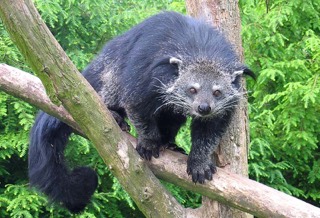 Binturong (reference photo)

Species Data
- Classification
- Carnivora / Viverridae Source
- Size
- Head-body length about 61–97 cm, tail about 56–89 cm
- Weight
- About 9–20 kg
- Diet
- Omnivore Omnivorous with a fruit-based diet, especially fond of figs; also eats insects, birds, small mammals, fish, and earthworms
- Activity
- Nocturnal and crepuscular; rests in tree hollows and similar spots during the day
- Distribution
- The binturong is native to South and Southeast Asia, including India, Nepal, Bhutan, southern China, Myanmar, Thailand, Laos, Cambodia, Vietnam, Malaysia, Indonesia, and the Philippines, inhabiting lowland forests from sea level up to 3,000 meters. Source
- Sources
- ja.wikipedia.org en.wikipedia.org
Did You Know?
- The binturong has a long, muscular, prehensile tail that can grip branches, and it often rests curled up with its tail wrapped around its body and head tucked beneath it. Source
- Binturongs are famous for a musky scent resembling popcorn or corn chips, likely caused by the volatile compound 2-acetyl-1-pyrroline found in their urine. Source
- Binturongs are among the few animals able to scarify the tough outer coating of fig seeds, making them a keystone species for dispersing strangler figs. Source
Where to See This Species
Operating facilities registered on this site: Japan 8
Utsunomiya DoubutsuenTochigiAbout 5 minutes from the Utsunomiya IC on the Tohoku Expressway; free parking for 1,000 cars.
Kumamotoshi DoushokubutsuenKumamotoTake the tram bound for Kengun and get off at the Doshokubutsuen-Iriguchi stop, then walk 10 minutes.
Noichi Zoological Park of Kochi PrefectureKochiA 20-minute walk or 13-minute rental-bicycle ride from Noichi Station on the Tosa Kuroshio Railway Gomen-Nahari Line.
Hirakawa ZooKagoshimaAbout a 20-minute walk from Goino Station on the JR Ibusuki-Makurazaki Line, or take a bus bound for Taniyama / Dobutsuen from Fukuhira Nokyo-mae to the last stop.
Shuunanshitokuyama DoubutsuenYamaguchiOpened in 1960
Naganoshichausuyama DoubutsuenNaganoThe nearest station is JR Shinonoi Station.
Fukuoka Zoo & Botanical GardenFukuokaOpened in 1953
Higashiyama Zoo and Botanical GardensAichiOpened in 1937
Former facilities
North Safari SapporoHokkaidoOpened in 2005
Closed: 2025-09-30 Official Site
Source links to official sites, official YouTube channels, and news aggregators such as Zoo Ring. Visit the publisher for the full item.
Conservation Story
Conservation Status
Vulnerable (VU)
Sources
Support Conservation
A visit is a small, positive way to support the daily lives of the animals you care about.
- Visit
- A visit itself helps support the facility.
- Animal Supporter Programs & Giving
- Find ways to support the facility through its official website.
- Furusato Nozei
- Municipally run facilities may share official guidance for this Japanese hometown-tax program.
FAQ
- Why does the binturong smell like popcorn?
- Its musk glands and urine contain the compound 2-acetyl-1-pyrroline, the same aromatic compound partly responsible for popcorn's smell. Source
- What is special about the binturong's tail?
- It is long, muscular, and prehensile — able to grip branches like a fifth limb — which is rare among carnivorans and helps the binturong move confidently through the treetops. Source
- Why is the binturong considered Vulnerable?
- Forest degradation from logging and conversion to plantations, along with hunting for meat, skins, and the illegal pet trade, have driven population declines across its range. Source
- How many operating facilities are registered here?
- Operating facilities registered on this site: Japan 8 Source
Books & gear
Source: ja.wikipedia.org en.wikipedia.org