Common Bottlenose Dolphinハンドウイルカ(バンドウイルカ)

Tursiops truncatusLC— Least Concern

The common bottlenose dolphin is a highly intelligent, social cetacean found in temperate and tropical waters worldwide, distinguished by its short, thick beak and curved dorsal fin. It lives in pods that typically number around 15 individuals, uses sophisticated echolocation to navigate and hunt, and is known for social memory that may last decades. Classified as Least Concern by the IUCN with a global population of roughly 600,000, it is also the dolphin species most frequently kept in aquariums, including those in Japan.
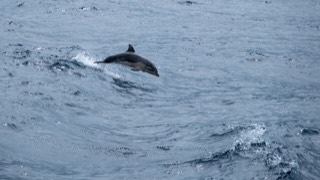
Common Bottlenose Dolphin (reference photo)
Photo: Jules Verne Times Two / CC BY-SA 4.0 / Source / cropped

Species Data

Classification
Artiodactyla / Delphinidae Source
Size
Body length 2–4 m (varies by region)
Weight
150–650 kg
Lifespan
About 40–60 years in the wild; the longest record in captivity is 51 years
Diet
Piscivore Feeds mainly on small fish, along with cephalopods such as squid and crustaceans such as crabs and krill
Activity
A highly social species active both day and night
Distribution
Distributed throughout temperate and tropical oceans worldwide, absent only from polar waters; the global population is estimated at around 600,000 individuals. Source

Did You Know?

  • Bottlenose dolphins are believed to have the longest social memory of any non-human species; studies have shown individuals can recognize the signature whistle of a former companion even after more than 20 years apart. Source
  • In Western Australia, some bottlenose dolphins have been observed carrying a marine sponge on their beak while foraging over sandy seafloor, apparently to protect their rostrum—a rare example of tool use first documented in 1997. Source
  • The Japanese name is written either "Handou-iruka" or "Bandou-iruka"; the latter, popularized by University of Tokyo researcher Shoji Nishiwaki, has become the standard term in aquariums and academic papers, and this species is the dolphin most commonly kept and shown at aquariums across Japan. Source

Where to See This Species

Operating facilities registered on this site: Japan 15

How to tell Dolphins, Porpoises, and Belugas apart →

Port of Nagoya Public AquariumAichi5 minutes on foot from Exit 3 of Nagoyako Station on the Subway Meiko Line (transfer to the Meiko Line at Sakae Station on the Higashiyama Line, or at Kanayama Station on the Meitetsu and JR lines).

Source

No.0143In residence

Yu

ユウ

Common Bottlenose DolphinTursiops truncatus

Sex
Female
Born
September 15, 2013
LC— Least Concern

Kyoto AquariumKyotoAbout a 15-minute walk from the central exit of JR Kyoto Station.

Source

Okinawa Churaumi AquariumOkinawaOpened in 2002

Source

Adventure WorldWakayamaOpened in 1978

Source

Awashima Marine ParkShizuokaOpened in 1963

Source

Kagoshima City AquariumKagoshimaFrom Kagoshima-Chuo Station, take the tram (Route 2) to the Suizokukan-guchi stop and walk 8 minutes.

Source

MARINE WORLD uminonakamichiFukuokaFrom JR Hakata Station, take the Kagoshima Main Line 11 minutes to Kashii Station, transfer to the JR Kashii Line (bound for Saitozaki), and ride 20 minutes to Uminonakamichi Station.

Source

Echizen Matsushima AquariumFukuiOpened in 1959

Source

Shimoda AquariumShizuokaOpened in 1967

Source

Kamogawa Sea WorldChibaAbout 2 hours from Tokyo Station on the Wakashio limited express to JR Awa-Kamogawa Station, then about 10 minutes by free shuttle bus (departing from the West Exit bus stop).

Source

Otaru AquariumHokkaidoOpened in 1958

Source

Kinosaki Marine WorldHyogoAbout 10 minutes by Zentan Bus from JR Kinosaki-Onsen Station; get off at the Hiyoriyama (Marine World) bus stop.

Source

ENOSHIMA AQUARIUMKanagawaOpened in 2004

Source

AQUARIUM ASAMUSHIAomoriOpened in 1983

Source

Minamichitabichi LandAichiOpened in 1980

Source

Former facilities

Keikyuuaburatsubomarin ParkKanagawaOpened in 1968

Source

Closed: 2021-09-30 Official Site

Closed: 2018-01-31 Official Site

Temporarily closed facilities

Shinyashima SuizokukanKagawaOpened in 1969

Source

No.0147In residence

Nana

ナナ

Common Bottlenose DolphinTursiops truncatus

Sex
Unknown
Born
Unknown
LC— Least Concern

Temporarily closed Official Site

Latest news

6

Open the news index

Source links to official sites, official YouTube channels, and news aggregators such as Zoo Ring. Visit the publisher for the full item.

Transferred or Residency Unconfirmed

No.0144Status pending

Lucky

ラッキー

Common Bottlenose DolphinTursiops truncatus

Port of Nagoya Public Aquarium

Sex
Male
Born
October 2024
LC— Least Concern

FAQ

How intelligent are bottlenose dolphins?
They are considered among the most cognitively sophisticated non-human animals, using signature whistles to identify individuals, sophisticated echolocation for hunting, and displaying what researchers describe as the longest social memory documented in any non-human species. Source
How long do bottlenose dolphins live?
In the wild they typically live 40 to 60 years, and in managed care the maximum recorded lifespan is 51 years. Source
Why does this species have two different Japanese names?
It was first named "Handou-iruka" based on an 1827 natural history text, but the alternate reading "Bandou-iruka," promoted by cetologist Shoji Nishiwaki of the University of Tokyo, became the standard used in most aquariums and scientific papers today. Source
How many operating facilities are registered here?
Operating facilities registered on this site: Japan 15 Source

Books & gear

Source: nagoyaaqua.jp www.kyoto-aquarium.com churaumi.okinawa churaumi.okinawa www.iucnredlist.org