Identification guide 09 species

How to Tell Dolphins, Porpoises, and Belugas Apart

There is no strict biological line between dolphins and whales: every animal here is a toothed whale. In Japanese, the familiar names tend to follow size, with around four metres often used as a rough convention. That is why the orca, the largest dolphin, and the large dolphin-family pilot whales are often called whales. Use size, markings, dorsal fins, beaks, and foreheads to enjoy both the animals and the naming puzzle.

Identification steps

5 steps

  1. 1

    Start with the overall body color

    If the whole body is white, it is a Beluga Whale. Black-and-white two-tone and large means a Killer Whale. A "panda pattern" — black head and tail with a white body — means a Commerson's Dolphin.

  2. 2

    Check for a dorsal fin

    No dorsal fin and a smooth back means either the small gray Finless Porpoise or the large white Beluga Whale. A well-developed, upright dorsal fin means a member of the oceanic dolphin family (Delphinidae).

  3. 3

    Know that "dolphin" vs "whale" is a naming convention based on size

    Drawing the line at roughly 4 m is common practice, not taxonomy. Killer whales and pilot whales are called whales because they are large members of the oceanic dolphin family, while the Finless Porpoise and Beluga Whale belong to different families.

  4. 4

    Look at the beak (rostrum)

    A long, slender beak projecting forward means a Common Bottlenose Dolphin. A round face with no beak points to the Finless Porpoise, Commerson's Dolphin, or Beluga Whale.

  5. 5

    Finish with the shape of the forehead

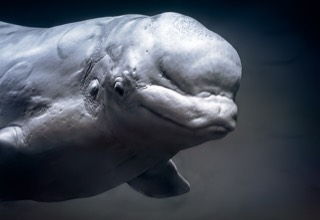
    Only the Beluga Whale has a large, rounded, bulging forehead and can turn its neck from side to side. This "mobile neck" is a rare trait among toothed whales.

Oceanic dolphins (Delphinidae) called "dolphins" (the Killer Whale is the largest member of the family)

4 species

Killer Whale
Photo: Robert Pittman / Public domain / Source / cropped

Identification specimen killer-whale

Killer Whaleシャチ

Orcinus orcaDD— Data Deficient

Size
About 5–9 m
Key features
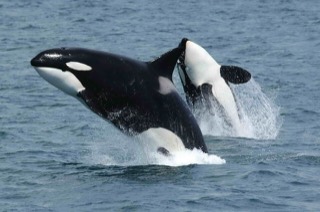
The largest member of the dolphin family. Black body with a white eye patch and belly, and a gray saddle patch on the back. The male's dorsal fin stands up to 1.8 m tall.
Habitat
Oceans worldwide
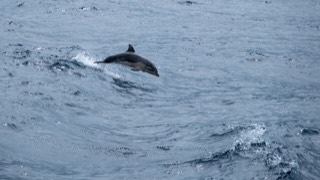
Common Bottlenose Dolphin
Photo: Jules Verne Times Two / CC BY-SA 4.0 / Source / cropped

Identification specimen bottlenose-dolphin

Common Bottlenose Dolphinハンドウイルカ(バンドウイルカ)

Tursiops truncatusLC— Least Concern

Size
About 2–4 m
Key features
The familiar "classic dolphin" of aquariums. Look for the forward-projecting beak, the upturned mouth that looks like a smile, and the sickle-shaped dorsal fin.
Habitat
Temperate and tropical seas worldwide
Pacific White-sided Dolphin
Photo: The original uploader was Leefon at English Wikipedia. / CC BY-SA 3.0 / Source / cropped

Identification specimen pacific-white-sided-dolphin

Pacific White-sided Dolphinカマイルカ

Lagenorhynchus obliquidensLC— Least Concern

Size
About 2.5 m
Key features
A dark back and light flanks in an hourglass pattern. The giveaway is the strongly curved, sickle-shaped dorsal fin that looks two-toned — dark on the leading edge and pale on the trailing edge. Listed here as Lagenorhynchus (reclassification to another genus has been proposed).
Habitat
Cool temperate North Pacific
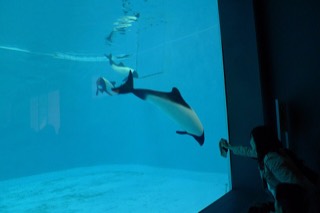
Commerson's Dolphin
Photo: Motokoka / CC BY-SA 4.0 / Source / cropped

Identification specimen commersons-dolphin

Commerson's Dolphinイロワケイルカ

Cephalorhynchus commersoniiLC— Least Concern

Size
About 1.3–1.7 m
Key features
A small species with a black head and tail and a white body — a color scheme that earned it the nickname "panda dolphin." No beak, and the dorsal fin is rounded.
Habitat
Around southern South America and the Kerguelen Islands

Oceanic dolphins (Delphinidae) called pilot whales or "whales" (in the dolphin family, but large)

3 species

Risso's Dolphin
Photo: OpenCage (Wikimedia Commons) / CC BY-SA 2.5 / Source / cropped

Identification specimen rissos-dolphin

Risso's Dolphinハナゴンドウ

Grampus griseusLC— Least Concern

Size
About 3–4 m
Key features
White linear scars accumulate over the body, so it looks whiter with age. The rounded head has a vertical crease on the forehead and no beak. In the dolphin family, though its Japanese name groups it with the pilot whales.
Habitat
Offshore tropical and temperate waters worldwide (depths of 400–1,000 m)
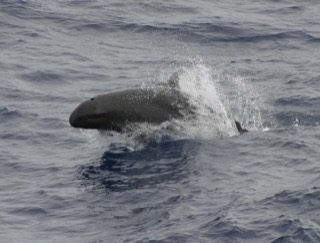
False Killer Whale
Photo: NOAA / SWFSC Protected Resources Division / Public domain / Source / cropped

Identification specimen false-killer-whale

False Killer Whaleオキゴンドウ

Pseudorca crassidensNT— Near Threatened

Size
Up to about 6 m
Key features
Almost uniformly black and slender. A hump-like bulge at the middle of the leading edge of the flipper gives it an S-shaped look. A large member of the dolphin family, grouped with the pilot whales in Japanese.
Habitat
Tropical and temperate open oceans worldwide
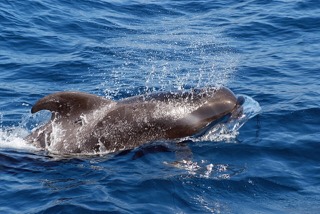
Short-finned Pilot Whale
Photo: Martina Nolte / CC BY-SA 3.0 de / Source / cropped

Identification specimen short-finned-pilot-whale

Short-finned Pilot Whaleコビレゴンドウ

Globicephala macrorhynchusLC— Least Concern

Size
About 4–7 m
Key features
A large, pot-shaped bulging forehead (melon) and an anchor-shaped white patch on the belly. A large pilot whale in the dolphin family, with a low, broad dorsal fin that sweeps backward.
Habitat
Tropical and temperate seas worldwide

Porpoises (Phocoenidae) — no dorsal fin, small

1 species

Finless Porpoise
Photo: ori2uru / CC BY 2.0 / Source / cropped

Identification specimen finless-porpoise

Finless Porpoiseスナメリ

Neophocaena asiaeorientalisEN— Endangered

Size
About 1.5–2 m
Key features
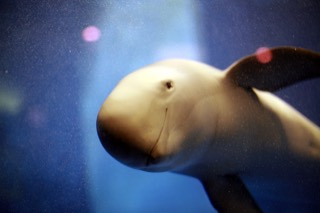
No dorsal fin at all — just a low ridge along the back. A small gray species with a round head and no beak, and a mouth that looks like it is smiling.
Habitat
Coasts and estuaries from Japan to Southeast Asia

Monodontidae — white body and rounded forehead

1 species

Beluga Whale
Photo: Sheila Sund / CC BY 2.0 / Source / cropped

Identification specimen beluga-whale

Beluga Whaleシロイルカ

Delphinapterus leucasLC— Least Concern

Size
About 3–5.5 m
Key features
Pure white all over, with a prominent rounded, bulging forehead (melon). No dorsal fin, only a low ridge. It moves its neck and produces a rich range of calls, earning the nickname "canary of the sea."
Habitat
Arctic Ocean and subarctic seas

Compare similar species

3 pairs

Finless Porpoise vs Beluga Whale

Two species with no dorsal fin. Told apart by size and color.

FeatureFinless PorpoiseBeluga Whale
Dorsal fin None (only a low ridge along the back) None (only a low ridge)
Size About 1.5–2 m (small) About 3–5.5 m (large)
Body color Gray Pure white all over
Forehead and neck Round head, no beak Large bulging forehead; can move its neck from side to side

Killer Whale, Bottlenose, and Commerson's

Three species in the same oceanic dolphin family, yet completely different in size and pattern.

FeatureKiller WhaleCommon Bottlenose DolphinCommerson's Dolphin
Size About 5–9 m (largest) About 2–4 m About 1.3–1.7 m (small)
Body pattern Black with a white eye patch and belly Gray all over Panda pattern — black head and tail, white body
Beak (rostrum) Inconspicuous Projects far forward None
Dorsal fin Stands up to 1.8 m in males Sickle-shaped Rounded

Risso's Dolphin vs Bottlenose Dolphin

Although Risso's Dolphin is grouped with the pilot whales in its Japanese name, which suggests a whale, it belongs to the oceanic dolphin family. Look at body features and classification rather than the name.

FeatureRisso's DolphinCommon Bottlenose Dolphin
Name and classification Called a pilot whale in Japanese, but in the oceanic dolphin family The classic dolphin by name, and in the oceanic dolphin family
Size About 3–4 m About 2–4 m
Face and body No beak; white scars and a vertical crease on the forehead Short, thick beak; gray body

Books & gear

Sources

Guide sources: ja.wikipedia.org en.wikipedia.org ja.wikipedia.org / Photos: see the Commons credit links beside each image.