Beluga Whaleシロイルカ

Delphinapterus leucasLC— Least Concern

The beluga whale is a highly social, vocal toothed whale of Arctic and sub-Arctic waters, easily recognized by its all-white body and lack of a dorsal fin. Unfused neck vertebrae let it swivel its head side to side, and its wide vocal repertoire has earned it the nickname 'canary of the sea.' While the species overall is Least Concern on the IUCN Red List, the isolated Cook Inlet population in Alaska is critically endangered, with only about 300 individuals remaining.
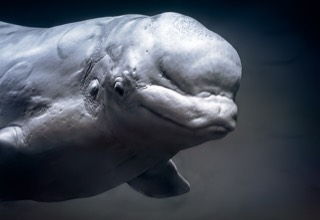
Beluga Whale (reference photo)
Photo: Sheila Sund / CC BY 2.0 / Source / cropped

Species Data

Classification
Artiodactyla (Cetacea) / Monodontidae Source
Distribution
Beluga whales have a circumpolar distribution across Arctic and sub-Arctic waters, including Hudson Bay, Greenland, the northern Bering Sea, and the Sea of Okhotsk, reaching as far as 76–80°N in summer. Southernmost populations occur in the St. Lawrence River and Sea of Okhotsk. Source

Did You Know?

  • Unlike most cetaceans, belugas have unfused neck vertebrae, letting them turn their heads laterally without rotating their whole body. Source
  • Belugas produce up to 11 distinct types of sounds — clicks, whistles, trills, and squawks among them — earning them the nickname 'canaries of the sea.' Source
  • Both wild and captive belugas have been reported to produce sounds that mimic the rhythm and tone of human speech. Source

Where to See This Species

3 facilities · 5 individuals

How to tell Dolphins, Porpoises, and Belugas apart →

Port of Nagoya Public AquariumAichi地下鉄名港線「名古屋港」駅3番出口から徒歩5分(東山線「栄」駅または名鉄線・JR線「金山」駅で名港線に乗り換え)。

北館「ベルーガプール」で複数個体を飼育・展示。 Source

No.0126In residence

Nana

ナナ

Beluga WhaleDelphinapterus leucas

Sex
Female
Born
July 25, 2007
LC— Least Concern

Shimane Aquarium AQUASShimaneJR波子駅から徒歩約12分(JR松江駅からJR波子駅まで2時間23分、JR益田駅から1時間24分)。

在籍個体を確認 Source

No.0128In residence

Shirya

シーリャ

Beluga WhaleDelphinapterus leucas

Sex
Male
Born
August 3, 2009
LC— Least Concern
No.0129In residence

Mirya

ミーリャ

Beluga WhaleDelphinapterus leucas

Sex
Female
Born
July 27, 2014
LC— Least Concern
No.0130In residence

Alan

アラン

Beluga WhaleDelphinapterus leucas

Sex
Male
Born
June 24, 2024
LC— Least Concern
No.0131In residence

Rirya

リーリャ

Beluga WhaleDelphinapterus leucas

Sex
Female
Born
July 1, 2024
LC— Least Concern

横浜・八景島シーパラダイス (Yokohamahakkeijimashiparadaisu)Kanagawa

1993年からシロイルカを展示。雄「プルル」・雌「シーマ」がライブスタジアムに出演。 Source

Latest news

4

Open the news index

Source links to official sites, official YouTube channels, and news aggregators such as Zoo Ring. Visit the publisher for the full item.

Conservation Story

Conservation Status

IUCNでは種全体としてLC(低危険種)に評価されているが、アラスカのクック湾個体群(推定約300頭)は米国絶滅危惧種法でCritically Endangered相当の深刻な危機的状況にある。

Habitat

北極圏・亜北極圏の海氷域を中心に、季節によって河口や湾内にも移動する。

Threats

Conservation & Breeding Efforts

Sources

en.wikipedia.org

Support Conservation

A visit is a small, positive way to support the daily lives of the animals you care about.

Visit
A visit itself helps support the facility.
Animal Supporter Programs & Giving
Find ways to support the facility through its official website.
Furusato Nozei
Municipally run facilities may share official guidance for this Japanese hometown-tax program.

Individuals Remembered

No.0127In memoriam

Hodoi

ホドイ

Beluga WhaleDelphinapterus leucas

Port of Nagoya Public Aquarium

Sex
Male
Born
Unknown
LC— Least Concern
No.0132In memoriam

Arya

アーリャ

Beluga WhaleDelphinapterus leucas

Shimane Aquarium AQUAS

Sex
Female
Born
Unknown
LC— Least Concern

FAQ

Why is the beluga whale called the canary of the sea?
Because of its wide range of vocalizations — up to 11 distinct sound types including clicks, whistles, trills, and squawks — which is unusually varied for a whale. Source
Are beluga whales endangered?
The species overall is Least Concern, but the Cook Inlet population in Alaska is critically endangered, with roughly 300 individuals left, due to development, boat traffic, and pollution. Source
Why can beluga whales turn their heads?
Unlike most whales, belugas have unfused neck vertebrae, which allows them to turn their heads laterally without rotating their entire body — an adaptation that helps with hunting and predator avoidance. Source

Source: www.seaparadise.co.jp nagoyaaqua.jp www.iucnredlist.org