Finless Porpoiseスナメリ

Neophocaena asiaeorientalisEN— Endangered

The finless porpoise is a small, dorsal-fin-less cetacean found in the coastal waters of East and South Asia, including the seas around Japan, as well as a critically endangered freshwater population in China's Yangtze River. It feeds mainly on fish, crustaceans, and cephalopods and shows notable social behavior, including allonursing and body-rubbing between individuals. While coastal populations have suffered long-term declines from bycatch and habitat degradation, the Yangtze population is in the most severe crisis, with only around 1,249 individuals estimated in 2023; the species overall is classified as Endangered by the IUCN.
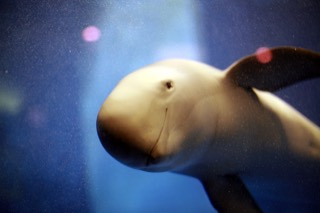
Finless Porpoise (reference photo)
Photo: ori2uru / CC BY 2.0 / Source / cropped

Species Data

Classification
Cetartiodactyla / Phocoenidae Source
Size
Body length about 1.5–2 m
Weight
About 50–60 kg
Lifespan
Usually does not exceed 20 years in the wild; the longest record in captivity is about 33 years (one individual lived 28.8 years)
Diet
Piscivore Carnivorous, feeding on fish, crustaceans, and cephalopods
Distribution
Finless porpoises inhabit coastal waters of East and South Asia, from the Persian Gulf through the Taiwan Strait to the Yellow Sea and Japan, with a distinct freshwater population in China's Yangtze River that is critically endangered. Source

Did You Know?

  • Lacking a long spinous process just behind the skull, finless porpoises can rotate their heads through a wide range of roughly 40 degrees. Source
  • In 1976, Toba Aquarium in Mie Prefecture, Japan, achieved the world's first successful captive breeding of the finless porpoise. Source
  • Genetic evidence indicates that Neophocaena represents the most basal living lineage within the porpoise family, making it evolutionarily significant among cetaceans. Source

Where to See This Species

Operating facilities registered on this site: Japan 4

Toba AquariumMieOpened in 1955

Source

No.0137In residence

Ichigo

イチゴ

Finless PorpoiseNeophocaena asiaeorientalis

Sex
Female
Born
May 15, 2013
EN— Endangered
No.0138In residence

Mario

マリオ

Finless PorpoiseNeophocaena asiaeorientalis

Sex
Male
Born
April 18, 2005
EN— Endangered
No.0139In residence

Peace

ピース

Finless PorpoiseNeophocaena asiaeorientalis

Sex
Male
Born
June 1, 2022
EN— Endangered
No.0140In residence

Go

ゴウ

Finless PorpoiseNeophocaena asiaeorientalis

Sex
Male
Born
Unknown
EN— Endangered

Miyajima Public AquariumHiroshimaOpened in 2011

Source

Osaka Aquarium KaiyukanOsakaOpened in 1990

Source

Port of Nagoya Public AquariumAichi5 minutes on foot from Exit 3 of Nagoyako Station on the Subway Meiko Line (transfer to the Meiko Line at Sakae Station on the Higashiyama Line, or at Kanayama Station on the Meitetsu and JR lines).

Source

Former facilities

Enoshima SuizokukanKanagawaOpened in 1954

Source

Closed: 2004-01 Official Site

Temporarily closed facilities

Shinyashima SuizokukanKagawaOpened in 1969

Source

Temporarily closed Official Site

Latest news

1

Open the news index

Source links to official sites, official YouTube channels, and news aggregators such as Zoo Ring. Visit the publisher for the full item.

Conservation Story

Conservation Status

Endangered (EN)

Sources

ja.wikipedia.org

Support Conservation

A visit is a small, positive way to support the daily lives of the animals you care about.

Visit
A visit itself helps support the facility.
Animal Supporter Programs & Giving
Find ways to support the facility through its official website.
Furusato Nozei
Municipally run facilities may share official guidance for this Japanese hometown-tax program.

Individuals Remembered

No.0141In memoriam

Yuki

勇気

Finless PorpoiseNeophocaena asiaeorientalis

Toba Aquarium

Sex
Female
Born
April 17, 1985
EN— Endangered
No.0142In memoriam

Wa

輪

Finless PorpoiseNeophocaena asiaeorientalis

Toba Aquarium

Sex
Female
Born
May 2, 2013
EN— Endangered

FAQ

Why doesn't the finless porpoise have a dorsal fin?
Instead of a true dorsal fin, it has a low ridge covered in thick skin with rows of tiny tubercles, an adaptation whose exact function is still studied by researchers. Source
Where can finless porpoises be found in Japan?
They occur in coastal waters from Sendai Bay in the north down to Tokyo Bay, Ise Bay, the Seto Inland Sea, and the coast of Nagasaki Prefecture, including Omura Bay and the Ariake Sea. Source
Is the finless porpoise endangered?
The species is classified as Endangered by the IUCN. Its most critical population lives in China's Yangtze River, where only about 1,249 individuals were estimated to remain in 2023. Source
How many operating facilities are registered here?
Operating facilities registered on this site: Japan 4 Source

Books & gear

Source: aquarium.co.jp aquarium.co.jp miyajima-aqua.jp www.iucnredlist.org