Killer Whaleシャチ

Orcinus orcaDD— Data Deficient

The killer whale, or orca (Orcinus orca), is the largest member of the dolphin family and an apex predator found in every ocean, from tropical waters to polar seas. Living in complex matrilineal pods with distinct hunting techniques and vocal dialects passed down across generations, it is considered one of the most socially sophisticated and intelligent marine mammals. The IUCN currently classifies it as Data Deficient, though specific populations such as the southern residents are listed as endangered.
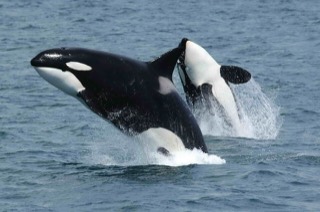
Killer Whale (reference photo)
Photo: Robert Pittman / Public domain / Source / cropped

Species Data

Classification
Artiodactyla / Delphinidae Source
Size
Males 6–8 m (maximum 9.8 m), females 5–7 m (maximum 8.5 m)
Weight
Males over 6 tons (maximum over 10 tons), females 3–4 tons
Lifespan
Wild: females 50–80 years (records exceeding 90 years), males about 29 years (up to 60 years); captive: average in the 20s, maximum in the 40s
Diet
Carnivore An apex predator with no natural enemies; preys on a wide range of animals, from fish such as salmonids and herring to sharks and rays, whales large and small, pinnipeds, sea otters, and seabirds, with each pod specializing in different prey
Activity
Shows a behavioral pattern combining foraging, travel, rest, and socializing, and may travel more than 100 km a day; swimming speed exceeds 50 km/h, with a maximum of 56 km/h
Distribution
Found in all oceans and most seas worldwide, with a preference for higher latitudes and coastal waters; densities are highest off Norway, the Aleutian Islands, the Gulf of Alaska, and in Antarctic waters. Around Japan it is most often sighted from the Kuril Islands to Hokkaido, though past hunting has limited current numbers. Source

Did You Know?

  • It forms complex matrilineal societies and exhibits distinct pod 'dialects,' with hunting techniques and vocalizations passed down across generations—evidence of animal culture. Source
  • It is the largest member of the dolphin family and one of the few animals known to undergo menopause, living decades beyond reproductive age. Source
  • In 2025, researchers documented the first known tool use in orcas, a behavior called 'allokelping' involving the manipulation of kelp. Source

Where to See This Species

Operating facilities registered on this site: Japan 4

Kamogawa Sea WorldChibaAbout 2 hours from Tokyo Station on the Wakashio limited express to JR Awa-Kamogawa Station, then about 10 minutes by free shuttle bus (departing from the West Exit bus stop).

Source

No.0111In residence

Rabi

ラビー

Killer WhaleOrcinus orca

Sex
Female
Born
January 11, 1998
DD— Data Deficient
No.0112In residence

Lala

ララ

Killer WhaleOrcinus orca

Sex
Female
Born
February 8, 2001
DD— Data Deficient
No.0113In residence

Luna

ルーナ

Killer WhaleOrcinus orca

Sex
Female
Born
July 19, 2012
DD— Data Deficient

Kobe Suma Sea WorldHyogoOpened in 2024

Source

No.0115In residence

Ran

ラン

Killer WhaleOrcinus orca

Sex
Female
Born
February 25, 2006
DD— Data Deficient
No.0116In residence

Stella

ステラ

Killer WhaleOrcinus orca

Sex
Female
Born
Unknown
DD— Data Deficient

Port of Nagoya Public AquariumAichi5 minutes on foot from Exit 3 of Nagoyako Station on the Subway Meiko Line (transfer to the Meiko Line at Sakae Station on the Higashiyama Line, or at Kanayama Station on the Meitetsu and JR lines).

Source

No.0117In residence

Rin

リン

Killer WhaleOrcinus orca

Sex
Female
Born
November 13, 2012
DD— Data Deficient

Adventure WorldWakayamaOpened in 1978

Source

Former facilities

Namegawaai LandChibaOpened in 1964

Source

Closed: 2001-08-31 Official Site

Latest news

3

Open the news index

Source links to official sites, official YouTube channels, and news aggregators such as Zoo Ring. Visit the publisher for the full item.

Conservation Story

Conservation Status

Data Deficient (DD)

Sources

en.wikipedia.org ja.wikipedia.org

Support Conservation

A visit is a small, positive way to support the daily lives of the animals you care about.

Visit
A visit itself helps support the facility.
Animal Supporter Programs & Giving
Find ways to support the facility through its official website.
Furusato Nozei
Municipally run facilities may share official guidance for this Japanese hometown-tax program.

Individuals Remembered

No.0114In memoriam

Oscar

オスカー

Killer WhaleOrcinus orca

Kamogawa Sea World

Sex
Male
Born
Unknown
DD— Data Deficient
No.0118In memoriam

Earth

アース

Killer WhaleOrcinus orca

Port of Nagoya Public Aquarium

Sex
Male
Born
October 13, 2008
DD— Data Deficient
No.0119In memoriam

Bingo

ビンゴ

Killer WhaleOrcinus orca

Port of Nagoya Public Aquarium

Sex
Male
Born
Unknown
DD— Data Deficient

FAQ

Is the killer whale actually a whale?
No, biologically it is the largest species of oceanic dolphin (family Delphinidae), not a true whale, despite its common name. Source
What threats do killer whales face?
Major threats include depletion of prey species like salmon, pollution from toxins such as PCBs, vessel noise and collisions, and historical capture for marine parks. Source
Why is the IUCN status listed as Data Deficient?
Because killer whale populations vary enormously in diet, behavior, and genetics across regions, the IUCN has not yet been able to assess the species as a single global population. Source
How many operating facilities are registered here?
Operating facilities registered on this site: Japan 4 Source

Books & gear

Source: www.kamogawa-seaworld.jp nagoyaaqua.jp www.kobesuma-seaworld.jp iucn-csg.org