Brown Bearヒグマ
Ursus arctosLC— Least Concern
The brown bear is one of the largest and most widespread bear species, ranging historically across Eurasia, North Africa, and North America and still found in large numbers in Russia today. Though often seen as a fierce carnivore, it is highly omnivorous, deriving up to 90% of its dietary energy from plant matter such as berries, roots, and grasses, supplemented with fish, insects, and occasional large prey. With a stable global population of roughly 200,000, the species is classified as Least Concern by the IUCN, even though several regional subspecies remain endangered.
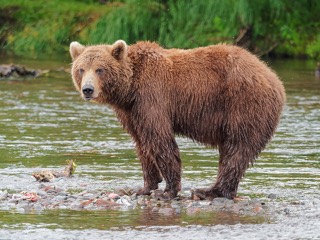 Brown Bear (reference photo)

Species Data
- Classification
- Carnivora / Ursidae Source
- Size
- Body length: males about 2.0–2.8 m, females about 1.8–2.2 m
- Weight
- Males about 250–500 kg, females about 100–300 kg
- Lifespan
- Wild: about 25 years
- Diet
- Omnivore Omnivorous but more carnivorous than the Asian black bear; eats mammals such as deer, wild boar, and mice, and salmon and trout, while also deriving much of its energy from plant matter such as berries, grasses, roots, fungi, and insects
- Activity
- Tends to have activity peaks in the morning and evening; hibernates in a den in winter, during which heart and breathing rates drop sharply, and gives birth during this period (usually around February)
- Distribution
- Brown bears historically ranged across Eurasia, North Africa, and North America, and today remain widespread in Russia and parts of Europe, Asia, and North America; in Japan they are found on Hokkaido. Source
- Sources
- ja.wikipedia.org en.wikipedia.org
Did You Know?
- Brown bears have a muscular hump on their shoulders, unique among bear species, believed to have evolved to power their strong digging ability. Source
- Brown bears in Yellowstone have been documented eating up to 40,000 army cutworm moths in a single day, deriving up to half their annual energy intake from these insects. Source
- Cubs learn much of their survival behavior by observation rather than instinct alone, watching their mothers to learn what to eat and how to hunt. Source
Where to See This Species
Operating facilities registered on this site: Japan 9
Adventure WorldWakayamaOpened in 1978
Noboribetsu BearParkHokkaidoOpened in 1958
OkuhidakumabokujouGifu2535 Hitoegane, Okuhida Onsengo, Takayama, Gifu.
Sapporoshimaruyama DoubutsuenHokkaidoOpened in 1951
TOBU ZOOSaitamaFrom Tobu-Dobutsu-Koen Station (west exit), about 10 minutes on foot (600 m) or about 5 minutes by bus.
Himeji Shiritsu DoubutsuenHyogoOpened in 1951
Hamamatsu Zoological GardensShizuokaOpened in 1950
Fuji Safari ParkShizuokaOpened in 1980
- 【東山動植物園公式】エゾヒグマ、ピポロⅡの来園29周年 ロングバージョン《 エゾヒグマ ヒグマ クマ 》
- 【謎】平川動物公園で「寝室と放飼場の出入りを自由にするとこのような行動を見せたエゾヒグマのナズナ」他 本日の注目情報セレクション
- 【東山動植物園公式】エゾヒグマ、ピポロⅡの来園29周年 ロングバージョン《 エゾヒグマ ヒグマ クマ 》
- 【東山動植物園公式】エゾヒグマ、ピポロⅡの来園29周年《 エゾヒグマ ヒグマ クマ 》
- ヒグマの展示について(8月25日 13時~非展示)
- 日替わり開催!8月の飼育員いちおし!
Source links to official sites, official YouTube channels, and news aggregators such as Zoo Ring. Visit the publisher for the full item.
Conservation Story
Conservation Status
Least Concern (LC)
Sources
Support Conservation
A visit is a small, positive way to support the daily lives of the animals you care about.
- Visit
- A visit itself helps support the facility.
- Animal Supporter Programs & Giving
- Find ways to support the facility through its official website.
- Furusato Nozei
- Municipally run facilities may share official guidance for this Japanese hometown-tax program.
FAQ
- Are brown bears mostly carnivores?
- No — despite their fearsome reputation, brown bears are highly omnivorous and get up to 90% of their dietary energy from plant matter like berries, grasses, roots, and fungi. Source
- What is the hump on a brown bear's shoulders?
- It's a mass of muscle, unique among bear species, that powers the brown bear's exceptionally strong digging ability. Source
- Are brown bears endangered?
- The species overall is Least Concern, with a stable global population of about 200,000, though some regional subspecies and isolated populations remain endangered. Source
- How many operating facilities are registered here?
- Operating facilities registered on this site: Japan 9 Source
Books & gear
Source: ja.wikipedia.org en.wikipedia.org