Crested Porcupineアフリカタテガミヤマアラシ
Hystrix cristataLC— Least Concern
The crested porcupine is one of the world's largest rodents, a nocturnal, monogamous animal native to Italy, North Africa, and much of sub-Saharan Africa. Covered in long, sharp quills — some of which rattle like a snake's tail when threatened — it feeds mainly on roots, bulbs, and leaves, supplementing its diet with gnawed bones for calcium. It is notably long-lived for a rodent, with individuals recorded living up to 28 years, and the IUCN classifies it as Least Concern.
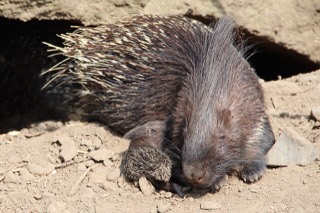 Crested Porcupine (reference photo)
.JPG)
Species Data
- Classification
- Rodentia / Hystricidae Source
- Size
- Head-body length about 60–93 cm, tail about 8–17 cm
- Weight
- About 10–30 kg
- Lifespan
- One individual lived about 28 years, making it the longest-lived rodent after the naked mole-rat
- Diet
- Herbivore Herbivorous, feeding mainly on roots and leaves, but also eats insects, small vertebrates, and carrion; habitually gnaws bones of other animals found outside its burrow for calcium and to wear down its teeth
- Activity
- Nocturnal; lives in monogamous family units
- Distribution
- The crested porcupine is found across Italy, North Africa, and West, Central, and East Africa — the only porcupine species found in Europe. Source
- Sources
- ja.wikipedia.org en.wikipedia.org
Did You Know?
- Some of its tail quills are hollow, and vibrating them produces a hiss-like rattle similar to a rattlesnake, used to warn off threats. Source
- It collects bones as a calcium source and can stockpile thousands of them in its underground burrow chambers. Source
- In Japan, the species was first successfully bred in captivity at Sapporo's Maruyama Zoo in 1977, with offspring later distributed to zoos nationwide. Source
Where to See This Species
Operating facilities registered on this site: Japan 10
Utsunomiya DoubutsuenTochigiAbout 5 minutes from the Utsunomiya IC on the Tohoku Expressway; free parking for 1,000 cars.
Yokohama Shiritsu Yokohama DoubutsuenKanagawaOpened in 1999
Sapporoshimaruyama DoubutsuenHokkaidoOpened in 1951
Akitashioomoriyama DoubutsuenAkitaFrom bus stop 7 at the west exit of the JR Akita Station bus terminal, take the Akita Chuo Kotsu "Araya Line" bus for about 30 minutes.
Naganoshichausuyama DoubutsuenNaganoThe nearest station is JR Shinonoi Station.
TOBU ZOOSaitamaFrom Tobu-Dobutsu-Koen Station (west exit), about 10 minutes on foot (600 m) or about 5 minutes by bus.
Hamamatsu Zoological GardensShizuokaOpened in 1950
Fuji Safari ParkShizuokaOpened in 1980
Fukuoka Zoo & Botanical GardenFukuokaOpened in 1953
Source links to official sites, official YouTube channels, and news aggregators such as Zoo Ring. Visit the publisher for the full item.
Conservation Story
Conservation Status
Least Concern (LC)
Sources
Support Conservation
A visit is a small, positive way to support the daily lives of the animals you care about.
- Visit
- A visit itself helps support the facility.
- Animal Supporter Programs & Giving
- Find ways to support the facility through its official website.
- Furusato Nozei
- Municipally run facilities may share official guidance for this Japanese hometown-tax program.
- Support Utsunomiya Doubutsuen
- Support Yokohama Shiritsu Yokohama Doubutsuen
- Support Sapporoshimaruyama Doubutsuen
- Support Akitashioomoriyama Doubutsuen
- Support Naganoshichausuyama Doubutsuen
- Support Ueno Zoo
- Support TOBU ZOO
- Support Hamamatsu Zoological Gardens
- Support Fuji Safari Park
- Support Fukuoka Zoo & Botanical Garden
FAQ
- How does the crested porcupine defend itself?
- Beyond its sharp quills, it has hollow tail quills that it vibrates to produce a hiss-like rattle similar to a rattlesnake, warning off potential predators before any physical contact. Source
- How long do crested porcupines live?
- They are unusually long-lived for rodents, with individuals recorded living up to 28 years — the second-longest lifespan of any rodent after the naked mole-rat. Source
- Why does the crested porcupine gnaw on bones?
- It gnaws bones found outside its burrow to obtain calcium and to keep its incisors worn down, and it often stockpiles thousands of collected bones underground. Source
- How many operating facilities are registered here?
- Operating facilities registered on this site: Japan 10 Source
Books & gear
Source: ja.wikipedia.org en.wikipedia.org