Great White Pelicanモモイロペリカン
Pelecanus onocrotalusLC— Least Concern
The great white pelican is one of the largest pelican species, a huge fish-eating waterbird found across swamps and lakes from southeastern Europe through Asia and Africa. It hunts cooperatively in groups, herding fish into shallow water before scooping them up together, and shows striking sexual dimorphism, with males roughly 30% heavier than females.
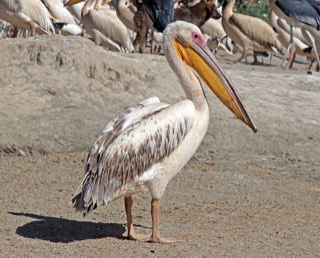 Great White Pelican (reference photo)
.jpg)
Species Data
- Classification
- Pelecaniformes / Pelecanidae Source
- Size
- 140–180 cm
- Weight
- Males average 9–15 kg, females 5.4–9 kg
- Lifespan
- No detailed records available
- Diet
- Piscivore Carnivorous, preying on fish under 30 cm long in both salt and fresh water, and occasionally on crustaceans and birds
- Distribution
- Breeds from southeastern Europe through Asia and Africa in swamps and shallow lakes; migratory populations winter from northeastern Africa through Iraq to northern India, while an African population of about 75,000 pairs is resident. Source
- Sources
- ja.wikipedia.org en.wikipedia.org
Did You Know?
- Groups of 5 to 10 birds cooperatively herd schools of fish, cutting off their escape before scooping them up together with their throat pouches. Source
- On South Africa's Dassen Island, breeding great white pelicans have been observed swallowing Cape gannet chicks whole to feed to their own young. Source
Where to See This Species
Operating facilities registered on this site: Japan 11
Adventure WorldWakayamaOpened in 1978
Sunshine AquariumTokyoFrom Ikebukuro Station (Exit 35), walk along Sunshine 60 Street.
Asahiyama ZooHokkaidoOpened in 1967
Izu Shaboten ZooShizuokaOpened in 1959
Kamogawa Sea WorldChibaAbout 2 hours from Tokyo Station on the Wakashio limited express to JR Awa-Kamogawa Station, then about 10 minutes by free shuttle bus (departing from the West Exit bus stop).
Sapporoshimaruyama DoubutsuenHokkaidoOpened in 1951
Otaru AquariumHokkaidoOpened in 1958
Toba AquariumMieOpened in 1955
TOBU ZOOSaitamaFrom Tobu-Dobutsu-Koen Station (west exit), about 10 minutes on foot (600 m) or about 5 minutes by bus.
Higashiyama Zoo and Botanical GardensAichiOpened in 1937
Wakayamajou Kouen DoubutsuenWakayamaOpened in 1919
Former facilities
North Safari SapporoHokkaidoOpened in 2005
Closed: 2025-09-30 Official Site
Source links to official sites, official YouTube channels, and news aggregators such as Zoo Ring. Visit the publisher for the full item.
Conservation Story
Conservation Status
Least Concern (LC)
Sources
Support Conservation
A visit is a small, positive way to support the daily lives of the animals you care about.
- Visit
- A visit itself helps support the facility.
- Animal Supporter Programs & Giving
- Find ways to support the facility through its official website.
- Furusato Nozei
- Municipally run facilities may share official guidance for this Japanese hometown-tax program.
FAQ
- How do great white pelicans catch fish?
- Groups of 5 to 10 birds work together to herd schools of fish into shallow water, cutting off their escape and then scooping them up simultaneously with their large throat pouches. Source
- How big is the great white pelican's wingspan?
- Its wingspan ranges from about 226 to 360 cm, among the largest of any bird, and it is the second-largest pelican species after the Dalmatian pelican. Source
- How many operating facilities are registered here?
- Operating facilities registered on this site: Japan 11 Source
Books & gear
Source: ja.wikipedia.org en.wikipedia.org