Masked Palm Civetハクビシン
Paguma larvataLC— Least Concern
The masked palm civet is a nocturnal, omnivorous carnivoran native across the Himalayas, Southeast Asia, and China, easily recognized by the distinctive white facial mask that gives it its name. It feeds mainly on fruit but also takes insects, small vertebrates, and eggs. Assessed as Least Concern by the IUCN, it drew global attention in 2003 when individuals sold at a Chinese wildlife market were found carrying SARS coronavirus.
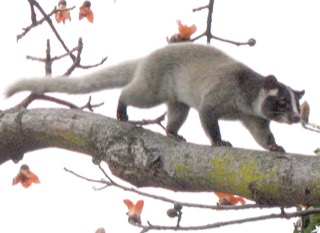 Masked Palm Civet (reference photo)
.jpg)
Species Data
- Classification
- Carnivora / Viverridae Source
- Size
- Body length 51–76 cm
- Weight
- 3.6–6 kg
- Lifespan
- Captive record of 24 years
- Diet
- Omnivore Omnivorous, feeding mainly on fruit such as figs, persimmons, pears, bananas, mangoes, and mandarin oranges, as well as insects, crustaceans, centipedes, earthworms, and bird eggs
- Activity
- Nocturnal; hides in its den during the day
- Distribution
- Native across the Himalayas, Nepal, Bangladesh, Southeast Asia, China, Taiwan, and Indonesia; whether Japan's population is native or introduced remains unresolved. Source
- Sources
- ja.wikipedia.org en.wikipedia.org
Did You Know?
- When alarmed, it sprays a foul-smelling secretion from its anal gland to deter predators. Source
- Unlike most civets, it can retract its claws in a cat-like manner. Source
- In 2003, masked palm civets sampled at a Guangdong wildlife market were found carrying SARS coronavirus, establishing a direct link in the animal-to-human transmission chain. Source
Where to See This Species
Operating facilities registered on this site: Japan 8
Iwate SafariParkIwateAbout 45 minutes from the Ichinoseki IC, about 30 minutes from the Wakayanagi-Kannari IC, or about 25 minutes via National Route 284.
Kiryuugaoka DoubutsuenGunmaIf driving, set your car navigation to "Kiryugaoka Amusement Park" (Kiryugaoka Yuenchi) rather than "Kiryugaoka Zoo" to reach the parking lot (searching by the zoo name may give an incorrect route).
Suzaka ZooNaganoFrom the Suzaka-Nagano-Higashi IC on the Joshin-etsu Expressway, take Route 403, turn right at the Kotaka-machi intersection, turn left at the Kami-Hatcho intersection, cross Garyu Bridge, and turn left for the south entrance.
Tennoji ZooOsakaOpened in 1915
Iida Shiritsu DoubutsuenNaganoAddress: 33 Ogimachi, Iida, Nagano.
Higashiyama Zoo and Botanical GardensAichiOpened in 1937
Wakayamajou Kouen DoubutsuenWakayamaOpened in 1919
Conservation Story
Conservation Status
Least Concern (LC)
Sources
Support Conservation
A visit is a small, positive way to support the daily lives of the animals you care about.
- Visit
- A visit itself helps support the facility.
- Animal Supporter Programs & Giving
- Find ways to support the facility through its official website.
- Furusato Nozei
- Municipally run facilities may share official guidance for this Japanese hometown-tax program.
FAQ
- What does a masked palm civet eat?
- It is omnivorous, feeding mainly on fruit such as figs, persimmons, and bananas, but also eating insects, small vertebrates, and bird eggs. Source
- Is the masked palm civet native to Japan?
- This is unresolved — researchers have not confirmed whether Japan's masked palm civet population is native or was introduced from elsewhere in Asia. Source
- Why is the masked palm civet linked to SARS?
- In 2003, individuals sold at a live-animal market in Guangdong, China, were found carrying SARS coronavirus, providing early evidence of the virus's animal origin. Source
- How many operating facilities are registered here?
- Operating facilities registered on this site: Japan 8 Source
Books & gear
Source: ja.wikipedia.org en.wikipedia.org