Moon Jellyfishミズクラゲ
Aurelia coeruleaNE— Not Evaluated
The moon jellyfish is one of the most common jellyfish in Japanese waters and across the Pacific Rim, easily recognized by its translucent bell and four horseshoe-shaped gonads. Its sting is mild and rarely painful to humans, but the species is prone to massive population blooms in nutrient-rich harbors, sometimes clogging fishing nets and power plant water intakes.
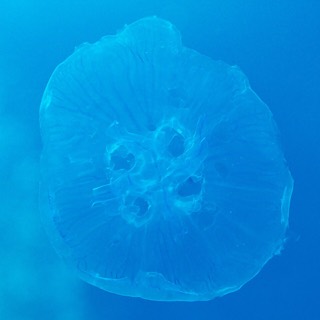 Moon Jellyfish (reference photo)
,_mar_Rojo,_Egipto,_2023-04-16,_DD_09.jpg)
Species Data
- Classification
- Semaeostomeae / Ulmaridae Source
- Size
- Bell diameter 15–30 cm in adults, occasionally larger
- Diet
- Planktivore Feeds mainly on zooplankton, and sometimes on fish larvae, mollusk larvae, and other jellyfish
- Distribution
- Native to the seas around Japan, China, Korea, and California, as well as the Mediterranean and other temperate waters, and now established worldwide in artificial habitats such as harbors, marinas, and cooling ponds. Source
- Sources
- ja.wikipedia.org en.wikipedia.org
Did You Know?
- Its stinging cells have short barbs that generally cannot penetrate human skin, so its sting is mild, usually causing only slight discomfort. Source
- Its polyps have remarkable regenerative ability, capable of regrowing even after being finely minced. Source
- The pulsing motion of its bell also functions like a pump, helping circulate fluid through its body. Source
Where to See This Species
Operating facilities registered on this site: Japan 8
KAMO AQUARIUMYamagataFrom JR Tsuruoka Station, take the Shonai Airport shuttle bus bound for Yunohama Onsen for about 40 minutes and get off at "Kamo Suizokukan"; the aquarium is right there (note that buses via Zenpoji do not stop here).
Kagoshima City AquariumKagoshimaFrom Kagoshima-Chuo Station, take the tram (Route 2) to the Suizokukan-guchi stop and walk 8 minutes.
Sumida AquariumTokyoRight by Tokyo Skytree Station on the Tobu Skytree Line.
NOTOJIMA AQUARIUMIshikawaThe nearest station is Wakura-Onsen Station.
Osaka Aquarium KaiyukanOsakaOpened in 1990
Kyoto AquariumKyotoAbout a 15-minute walk from the central exit of JR Kyoto Station.
Nagasakipengin SuizokukanNagasakiOpened in 2001
Toba AquariumMieOpened in 1955
Former facilities
Marinpiamatsushima SuizokukanMiyagiOpened in 1927
Closed: 2015-05-10 Official Site
- 深夜のクラゲライブ|オールナイトカモスイ ミズクラゲ (エフィラ)
- 「全部同じ」に見えるミズクラゲ🪼#京都水族館 #kyotoaquarium #ミズクラゲ #京都観光
- ミズクラゲオールナイトカモスイ開催中 #加茂水族館 #オールナイトカモスイ #ミズクラゲ #live #relaxing
- 4つ並んだバックヤードのミズクラゲ(Aurelia coerulea)の育成水槽。右から生後2-3週、3-4週、4-5週、5-6週。その後は、クラゲドリームシアターデビューです♪
- ミズクラゲのエフィラ
- ミズクラゲ:宮島水族館
Source links to official sites, official YouTube channels, and news aggregators such as Zoo Ring. Visit the publisher for the full item.
Conservation Story
Conservation Status
Not Evaluated (NE)
Sources
Support Conservation
A visit is a small, positive way to support the daily lives of the animals you care about.
- Visit
- A visit itself helps support the facility.
- Animal Supporter Programs & Giving
- Find ways to support the facility through its official website.
- Furusato Nozei
- Municipally run facilities may share official guidance for this Japanese hometown-tax program.
FAQ
- Is the moon jellyfish dangerous to humans?
- No, its stinging cells have barbs too short to penetrate human skin, so its sting is mild and usually just mildly irritating. Source
- Why do moon jellyfish sometimes appear in huge numbers?
- They thrive in nutrient-rich, artificial environments like harbors and marinas, which can trigger large population blooms that clog fishing nets and cooling water intakes at power plants. Source
- What do moon jellyfish eat?
- They feed mainly on zooplankton, occasionally taking small fish larvae, mollusk larvae, and even other jellyfish. Source
- How many operating facilities are registered here?
- Operating facilities registered on this site: Japan 8 Source
Books & gear
Source: kamo-kurage.jp www.nikkei.com masukoap.com