Steller's Sea Eagleオオワシ
Haliaeetus pelagicusVU— Vulnerable
Steller's sea eagle is one of the largest and heaviest eagles in the world, breeding along Russia's Kamchatka Peninsula, the Sea of Okhotsk coast, and the lower Amur River, with wintering birds reaching Korea, Japan, and China. It feeds mainly on salmon and other fish, supplemented by waterbirds, small mammals, and carrion. Classified as Vulnerable with a declining population estimated at around 5,000 individuals, it is protected in Japan as a Natural Monument.
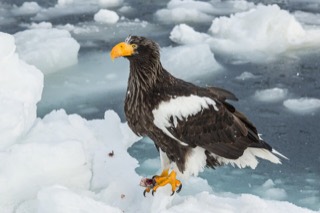 Steller's Sea Eagle (reference photo)
.jpg)
Species Data
- Classification
- Accipitriformes / Accipitridae Source
- Size
- Males total length about 88 cm / females about 102 cm; wingspan 220–250 cm
- Weight
- Males 4.9–6.8 kg / females 6.2–9.5 kg (considered the heaviest living eagle)
- Lifespan
- Said to live about 30 years in the wild
- Diet
- Carnivore Mainly fish such as pink salmon, chum salmon, and walleye pollock; also eats birds such as ducks, small to medium mammals, and the carcasses of seals and whales
- Distribution
- Endemic to northeastern Asia, breeding on Russia's Kamchatka Peninsula, near the Sea of Okhotsk, and the lower Amur River; winter migrants reach Korea, Japan, and China. Source
- Sources
- ja.wikipedia.org en.wikipedia.org
Did You Know?
- Among the largest eagles seen in Japan, it was designated a national Natural Monument in 1970 and a National Endangered Species of Wild Fauna and Flora in 1993. Source
- Steller's sea eagles have 14 tail feathers, more than the 12 typically found in other sea eagles. Source
- The global population is estimated at around 5,000 individuals and is declining. Source
Where to See This Species
Operating facilities registered on this site: Japan 6
Asahiyama ZooHokkaidoOpened in 1967
Yokohama Shiritsu Yokohama DoubutsuenKanagawaOpened in 1999
Sapporoshimaruyama DoubutsuenHokkaidoOpened in 1951
Hamamatsu Zoological GardensShizuokaOpened in 1950
Fukuoka Zoo & Botanical GardenFukuokaOpened in 1953
Conservation Story
Conservation Status
Vulnerable (VU)
Sources
Support Conservation
A visit is a small, positive way to support the daily lives of the animals you care about.
- Visit
- A visit itself helps support the facility.
- Animal Supporter Programs & Giving
- Find ways to support the facility through its official website.
- Furusato Nozei
- Municipally run facilities may share official guidance for this Japanese hometown-tax program.
FAQ
- How big is Steller's sea eagle?
- It is considered the heaviest eagle species in the world, with females weighing up to 9.5 kg and a wingspan of 220–250 cm. Source
- What does Steller's sea eagle eat?
- It feeds mainly on fish such as salmon and pollock, along with waterbirds, small to medium mammals, and carrion including seals and whales. Source
- Is Steller's sea eagle endangered?
- It is classified as Vulnerable by the IUCN, with a declining global population estimated at around 5,000 individuals. Source
- How many operating facilities are registered here?
- Operating facilities registered on this site: Japan 6 Source
Books & gear
Source: ja.wikipedia.org en.wikipedia.org