Sulphur-crested Cockatooキバタン

Cacatua galeritaLC— Least Concern

The sulphur-crested cockatoo is a large, gregarious white parrot native to Australia, New Guinea, and nearby islands, easily recognized by its sulfur-yellow crest. It forms noisy flocks that forage on the ground and in trees for seeds, nuts, and fruit, and is renowned for its intelligence, long lifespan, and remarkable ability to adapt to urban environments.

Operating facilities registered on this site: Japan 7 (ITOZU NO MORI Zoological Park, Zoo in Okazaki, Aichi, Fukuchiyama City Zoo, and 4 more). These facilities are confirmed by resident animal records or the facility’s official information.
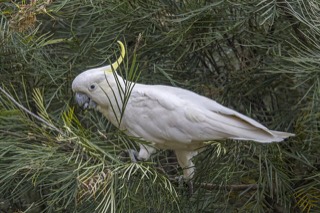
Sulphur-crested Cockatoo (reference photo)
Photo: Charles J. Sharp / CC BY-SA 4.0 / Source / cropped

Species Data

Classification
Psittaciformes / Cacatuidae Source
Size
44–55 cm
Weight
Around 800 g
Lifespan
Wild: about 20–40 years / captive: over 70 years (records exceeding 100 years exist)
Diet
Omnivore Feeds mainly on plant matter such as seeds, nuts, roots, fruit, and flowers, and also on insects and larvae under bark and in the soil
Activity
Diurnal
Distribution
Native to Australia (northern and eastern regions, plus Tasmania), New Guinea, and nearby islands; introduced populations have also become established in places such as Singapore and New Zealand. Source

Did You Know?

  • Urban populations in cities such as Sydney have learned to flip open the lids of household garbage bins to find food, a behavior that spreads through social imitation among the birds. Source
  • A 2009 study of a sulphur-crested cockatoo named Snowball found it could synchronize its movements to a musical beat, offering evidence that the capacity for rhythmic entrainment is not unique to humans. Source

Where to See This Species

Operating facilities registered on this site: Japan 7

ITOZU NO MORI Zoological ParkFukuokaOpened in 2002

Source

No.0511In residence

Kick

キック

Sulphur-crested CockatooCacatua galerita

Sex
Unknown
Born
Unknown
LC— Least Concern
No.1010In residence

Lee

リー

Sulphur-crested CockatooCacatua galerita

Sex
Unknown
Born
Unknown
LC— Least Concern

Zoo in Okazaki, AichiAichiAbout 1 km toward Toyota from the Okazaki IC on the Tomei Expressway.

Source

Fukuchiyama City ZooKyotoInside Sandanike Park.

Source

HIMEJI CENTRAL PARKHyogoFrom the north exit of JR Himeji Station, take the Shinki Bus bound for Himeji Central Park (fare: adults ¥590, children ¥300).

Source

KOBE ANIMAL KINGDOMHyogoRight by Keisan Kagaku Center Station (Kobe Animal Kingdom / Fugaku-mae) on the Port Liner.

Source

Obihiro ZooHokkaidoFrom Obihiro Station, take the Tokachi Bus (Route 70, bound for Ozora Danchi) for about 18 minutes to the Dobutsuen-mae stop, then walk about 300 m; or take the Takushoku Bus for about 16 minutes to the Midorigaoka 6-chome Hakubutsukan Iriguchi stop, then walk about 600 m.

Source

Utsunomiya ZooTochigiAbout 5 minutes from the Utsunomiya IC on the Tohoku Expressway; free parking for 1,000 cars.

Source

Possible records, not yet confirmed: 5

These facilities are not confirmed by an official animal list. They appear in secondary sources such as Wikipedia; check the facility’s official website for current exhibits.

Adventure WorldWakayamaOpened in 1978

(Not confirmed by official sources) Source

Kyoto City ZooKyotoOpened in 1903

(Not confirmed by official sources) Source

Zoo in Kiryū, GunmaGunmaOpened in 1953

(Not confirmed by official sources) Source

Tennoji ZooOsakaOpened in 1915

(Not confirmed by official sources) Source

Fukuoka Zoo & Botanical GardenFukuokaOpened in 1953

(Not confirmed by official sources) Source

Latest news

3

Open the news index

Source links to official sites, official YouTube channels, and news aggregators such as Zoo Ring. Visit the publisher for the full item.

Conservation Story

Conservation Status

Least Concern (LC)

Sources

ja.wikipedia.org

Support Conservation

A visit is a small, positive way to support the daily lives of the animals you care about.

Visit
A visit itself helps support the facility.
Animal Supporter Programs & Giving
Find ways to support the facility through its official website.
Furusato Nozei
Municipally run facilities may share official guidance for this Japanese hometown-tax program.

FAQ

Where can I see Sulphur-crested Cockatoo in Japan?
Operating facilities registered on this site: Japan 7 (ITOZU NO MORI Zoological Park, Zoo in Okazaki, Aichi, Fukuchiyama City Zoo, and 4 more). These facilities are confirmed by resident animal records or the facility’s official information. Source
How long do sulphur-crested cockatoos live?
In the wild they typically live 20 to 40 years, while captive birds commonly live past 70 years, with some verified individuals surpassing 100. Source
What do sulphur-crested cockatoos eat?
They feed mainly on seeds, nuts, roots, and fruit, foraging both on the ground and in trees, and also eat insects and their larvae found under bark or in soil. Source

Books & gear

Source: ja.wikipedia.org en.wikipedia.org