White-naped Craneマナヅル
Antigone vipioVU— Vulnerable
The white-naped crane is a large, slender crane named for the white stripe running down the back of its grey neck, breeding across northeastern Mongolia, China, and southeastern Russia before migrating to winter in Japan and the Korean Peninsula. Listed as Vulnerable, it faces mounting pressure from wetland loss, and roughly half of Japan's wintering population crowds into the Izumi Plain in Kagoshima Prefecture.
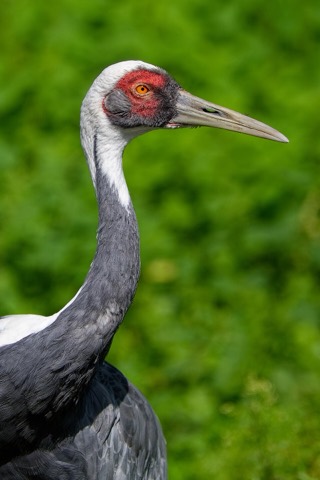 White-naped Crane (reference photo)

Species Data
- Classification
- Gruiformes / Gruidae Source
- Size
- About 112–153 cm
- Weight
- About 5.6 kg
- Lifespan
- The longest recorded lifespan in captivity is 45 years (according to the AnAge aging research database)
- Diet
- Omnivore In rice paddies and wetlands it eats fish, insects, frogs, the rhizomes and roots of sedges and aquatic plants, and seeds; on farmland in its wintering grounds it also feeds on rice and grain
- Distribution
- Breeds in northeastern Mongolia, northeastern China, and adjacent southeastern Russia in summer, and winters mainly in Japan and the Korean Peninsula, with Japan's population concentrated on the Izumi Plain in Kagoshima Prefecture. Source
Did You Know?
- Nearly half of the world's white-naped cranes winter in the small Izumi Plain area of Kagoshima Prefecture, Japan, a concentration that raises serious concern about the risk of disease outbreaks wiping out a large share of the population at once. Source
- As of 2018, an estimated 3,700 to 4,500 mature individuals remained in the wild, with Mongolia holding at least half the population; chicks fledge 70 to 75 days after hatching and reach sexual maturity between 2 and 3 years of age. Source
Where to See This Species
Operating facilities registered on this site: Japan 7
Ishikawa DoubutsuenIshikawaAbout 60 minutes from the Kanazawa-Morimoto Interchange on the Hokuriku Expressway, about 40 minutes from the Kanazawa-Nishi Interchange, and about 20 minutes from the Komatsu Interchange.
Saitamakenkodomodoubutsu Shizen KouenSaitamaOpened in 1980
Hirakawa ZooKagoshimaAbout a 20-minute walk from Goino Station on the JR Ibusuki-Makurazaki Line, or take a bus bound for Taniyama / Dobutsuen from Fukuhira Nokyo-mae to the last stop.
Nagasaki Bio ParkNagasakiOpened in 1980
Iida Shiritsu DoubutsuenNaganoAddress: 33 Ogimachi, Iida, Nagano.
Hamamatsu Zoological GardensShizuokaOpened in 1950
Source links to official sites, official YouTube channels, and news aggregators such as Zoo Ring. Visit the publisher for the full item.
Conservation Story
Conservation Status
Vulnerable (VU)
Sources
Support Conservation
A visit is a small, positive way to support the daily lives of the animals you care about.
- Visit
- A visit itself helps support the facility.
- Animal Supporter Programs & Giving
- Find ways to support the facility through its official website.
- Furusato Nozei
- Municipally run facilities may share official guidance for this Japanese hometown-tax program.
FAQ
- Where do white-naped cranes spend the winter in Japan?
- Most of Japan's wintering white-naped cranes concentrate on the Izumi Plain in Kagoshima Prefecture, a site so important that it hosts a large share of the entire wild population. Source
- How many white-naped cranes remain in the wild?
- As of 2018, an estimated 3,700 to 4,500 mature individuals remained, with Mongolia hosting at least half of the total population. Source
- How many operating facilities are registered here?
- Operating facilities registered on this site: Japan 7 Source
Books & gear
Source: ja.wikipedia.org en.wikipedia.org