Japanese Spider Crabタカアシガニ
Macrocheira kaempferiDD— Data Deficient
The Japanese spider crab is the largest living arthropod by leg span, reaching nearly 4 meters from claw to claw in the deep waters off southern Japan. Despite its fearsome appearance, it has a gentle, slow-moving temperament, which along with its longevity makes it a popular deep-sea aquarium exhibit.
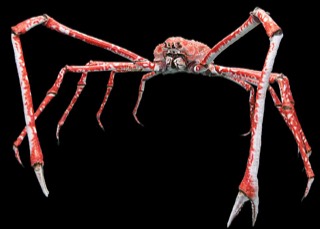 Japanese Spider Crab (reference photo)

Species Data
- Classification
- Decapoda / Macrocheiridae Source
- Size
- Maximum leg span 3.7–3.8 m and carapace width up to 40 cm; considered the largest living arthropod by leg span
- Weight
- Weight up to 19 kg
- Diet
- Omnivore Omnivore with a strong animal bias; cracks shells open with its claws to eat the contents and also feeds on dead fish and similar carrion
- Distribution
- Found mainly off southern Honshu, Japan, from around Tokyo Bay to Kagoshima, typically inhabiting depths of 150-800 m, though adults may move into shallower water around 50 m during the breeding season. Source
- Sources
- ja.wikipedia.org en.wikipedia.org
Did You Know?
- It belongs to a phylogenetically ancient lineage of crabs and is sometimes referred to as a "living fossil." Source
- Despite its intimidating appearance, it has a gentle disposition and moves slowly, making it well suited to long-term display in aquariums. Source
- Females have been observed tearing off sponges and other organisms with their claws and attaching them to their shells as camouflage. Source
Where to See This Species
Operating facilities registered on this site: Japan 9
Kagoshima City AquariumKagoshimaFrom Kagoshima-Chuo Station, take the tram (Route 2) to the Suizokukan-guchi stop and walk 8 minutes.
NOTOJIMA AQUARIUMIshikawaThe nearest station is Wakura-Onsen Station.
Aquamarine FukushimaFukushimaOpened in 2000
Shimoda AquariumShizuokaOpened in 1967
Osaka Aquarium KaiyukanOsakaOpened in 1990
Gamagoorishitakeshima SuizokukanAichiOpened in 1956
Kinosaki Marine WorldHyogoAbout 10 minutes by Zentan Bus from JR Kinosaki-Onsen Station; get off at the Hiyoriyama (Marine World) bus stop.
Nagasakipengin SuizokukanNagasakiOpened in 2001
Former facilities
Closed: 2018-01-31 Official Site
Source links to official sites, official YouTube channels, and news aggregators such as Zoo Ring. Visit the publisher for the full item.
Conservation Story
Conservation Status
Data Deficient (DD)
Sources
Support Conservation
A visit is a small, positive way to support the daily lives of the animals you care about.
- Visit
- A visit itself helps support the facility.
- Animal Supporter Programs & Giving
- Find ways to support the facility through its official website.
- Furusato Nozei
- Municipally run facilities may share official guidance for this Japanese hometown-tax program.
FAQ
- How big does the Japanese spider crab get?
- Its leg span can reach up to about 3.7-3.8 m from claw to claw, with a carapace up to 40 cm wide and a body weight of up to 19 kg, making it the largest living arthropod by leg span. Source
- Is the Japanese spider crab dangerous?
- No. Despite its intimidating size and appearance, it has a gentle disposition and moves slowly, which is why it is commonly kept and displayed in aquariums. Source
- How deep does the Japanese spider crab live?
- It typically inhabits depths of about 150-800 m, most commonly 200-300 m, off southern Japan, though it moves into shallower water around 50 m to breed. Source
- How many operating facilities are registered here?
- Operating facilities registered on this site: Japan 9 Source
Books & gear
Source: ja.wikipedia.org en.wikipedia.org