Moray Eelウツボ
Gymnothorax kidakoLC— Least Concern
The kidako moray (Gymnothorax kidako), known in Japan as utsubo, is a large moray eel reaching up to about 91 cm long, found across the western Pacific from Taiwan to Japan on coral reefs, lagoons, and rocky coasts down to roughly 400 m. Unusually for a moray, it is more active during the day than at night, hunting fish, octopus, and squid with sharp canine-like teeth and a second set of pharyngeal jaws in its throat. It is eaten as food in parts of Japan and is listed as Least Concern by the IUCN.
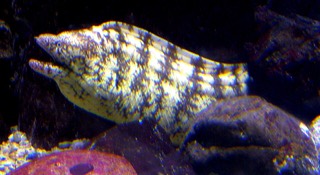 Moray Eel (reference photo)

Species Data
- Classification
- Anguilliformes / Muraenidae Source
- Size
- Maximum total length about 91 cm
- Diet
- Piscivore Carnivorous fish that preys on fish, cephalopods such as octopus and squid, and crustaceans
- Activity
- Diurnal (most moray eels are nocturnal, but this species is unusual in being active by day)
- Distribution
- Found in the western Pacific from Taiwan to Japan, inhabiting coral reefs, lagoons, and rocky coasts, and occasionally deeper waters down to about 400 m. Source
- Sources
- ja.wikipedia.org en.wikipedia.org
Did You Know?
- It has sharp, canine-like teeth at the front of its upper jaw and a second set of jaws, called pharyngeal jaws, in its throat used to pull prey inward. Source
- While most morays are nocturnal, this species is unusually active during the day. Source
- In Japan it is eaten as food in some regions, prepared as sashimi or fried dishes. Source
Where to See This Species
Operating facilities registered on this site: Japan 8
Kagoshima City AquariumKagoshimaFrom Kagoshima-Chuo Station, take the tram (Route 2) to the Suizokukan-guchi stop and walk 8 minutes.
Sunshine AquariumTokyoFrom Ikebukuro Station (Exit 35), walk along Sunshine 60 Street.
NOTOJIMA AQUARIUMIshikawaThe nearest station is Wakura-Onsen Station.
Murotohaikou SuizokukanKochiOpened in 2018
Shimoda AquariumShizuokaOpened in 1967
Osaka Aquarium KaiyukanOsakaOpened in 1990
Katsurahama AquariumKochiOpened in 1931
Nagasakipengin SuizokukanNagasakiOpened in 2001
Source links to official sites, official YouTube channels, and news aggregators such as Zoo Ring. Visit the publisher for the full item.
Conservation Story
Conservation Status
Least Concern (LC)
Sources
Support Conservation
A visit is a small, positive way to support the daily lives of the animals you care about.
- Visit
- A visit itself helps support the facility.
- Animal Supporter Programs & Giving
- Find ways to support the facility through its official website.
- Furusato Nozei
- Municipally run facilities may share official guidance for this Japanese hometown-tax program.
FAQ
- What does the kidako moray eat?
- It is piscivorous, preying on fish along with octopus and squid. Source
- Is the kidako moray dangerous to divers?
- Attacks on humans are rare and typically occur only when a diver puts a hand into a reef crevice where the eel is hiding. Source
- Is the kidako moray active during the day or at night?
- Unlike most moray eels, which are nocturnal, this species is unusually active during the daytime. Source
- How many operating facilities are registered here?
- Operating facilities registered on this site: Japan 8 Source
Books & gear
Source: ja.wikipedia.org en.wikipedia.org