Patagonian Maraマーラ

Dolichotis patagonumLC— Least Concern

The Patagonian mara is a large, long-legged rodent endemic to Argentina, resembling a cross between a rabbit and a small deer. It forms lifelong monogamous pairs that often share communal breeding warrens with dozens of other pairs, taking turns guarding the young. A fast runner capable of speeds up to 45 km/h, it is classified as Least Concern by the IUCN though it has declined in parts of its range.

Operating facilities registered on this site: Japan 15 (HIMEJI CENTRAL PARK, Utsunomiya Zoo, Zoo in Okazaki, Aichi, and 12 more). These facilities are confirmed by resident animal records or the facility’s official information.
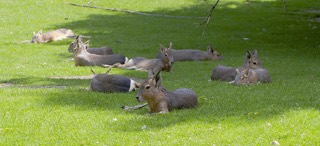
Patagonian Mara (reference photo)
Photo: Diego Delso / CC BY-SA 3.0 / Source / cropped

Species Data

Classification
Rodentia / Caviidae Source
Size
Body length 69–75 cm
Weight
8–16 kg
Diet
Herbivore Herbivorous, feeding mainly on monocots (in the Monte Desert, 70% monocots and 30% dicots)
Activity
Diurnal
Distribution
Endemic to Argentina, ranging from roughly 28° to 50°S and including Patagonia. Source

Did You Know?

  • Capable of running at speeds up to 45 km/h, making it one of the fastest rodents when fleeing predators. Source
  • Pairs are monogamous and remain together for life, with a partner typically replaced only after the other's death. Source
  • Multiple pairs share communal breeding warrens, with as many as 29 pairs using the same den site, taking turns standing guard over the young. Source

Where to See This Species

Operating facilities registered on this site: Japan 15

HIMEJI CENTRAL PARKHyogoFrom the north exit of JR Himeji Station, take the Shinki Bus bound for Himeji Central Park (fare: adults ¥590, children ¥300).

Source

No.0119In residence

Bisu

ビース

Patagonian MaraDolichotis patagonum

Sex
Female
Born
Unknown
LC— Least Concern
No.0815In residence

Nane

ナネ

Patagonian MaraDolichotis patagonum

Sex
Male
Born
Unknown
LC— Least Concern

Utsunomiya ZooTochigiAbout 5 minutes from the Utsunomiya IC on the Tohoku Expressway; free parking for 1,000 cars.

Source

Zoo in Okazaki, AichiAichiAbout 1 km toward Toyota from the Okazaki IC on the Tomei Expressway.

Source

Saitama Children's ZooSaitamaOpened in 1980

Source

Hirakawa ZooKagoshimaAbout a 20-minute walk from Goino Station on the JR Ibusuki-Makurazaki Line, or take a bus bound for Taniyama / Dobutsuen from Fukuhira Nokyo-mae to the last stop.

Source

Tennoji ZooOsakaOpened in 1915

Source

Fuji Safari ParkShizuokaOpened in 1980

Source

Fukuchiyama City ZooKyotoInside Sandanike Park.

Source

Gunma Safari ParkGunmaOpened in 1979

Source

Hitachi Kamine ZooIbarakiAbout 5 minutes from the Hitachi-Chuo Interchange on the Joban Expressway via National Route 6.

Source

Inokashira Park ZooTokyoOpened in 1942

Source

Izu Animal KingdomShizuokaOpened in 1977

Source

Kanazawa ZooKanagawaOpened in 1982

Source

KOBE ANIMAL KINGDOMHyogoRight by Keisan Kagaku Center Station (Kobe Animal Kingdom / Fugaku-mae) on the Port Liner.

Source

Nasu Animal KingdomTochigiAbout 50 minutes by car from Nasu-Shiobara Station on the Tohoku Shinkansen (a free shuttle bus is available; online reservation required by 17:00 the day before).

Source

Possible records, not yet confirmed: 7

These facilities are not confirmed by an official animal list. They appear in secondary sources such as Wikipedia; check the facility’s official website for current exhibits.

Adventure WorldWakayamaOpened in 1978

(Not confirmed by official sources) Source

Ishikawa ZooIshikawaAbout 60 minutes from the Kanazawa-Morimoto Interchange on the Hokuriku Expressway, about 40 minutes from the Kanazawa-Nishi Interchange, and about 20 minutes from the Komatsu Interchange.

(Not confirmed by official sources) Source

Izu Shaboten ZooShizuokaOpened in 1959

(Not confirmed by official sources) Source

Zoo in Kiryū, GunmaGunmaOpened in 1953

(Not confirmed by official sources) Source

Nagasaki Bio ParkNagasakiOpened in 1980

(Not confirmed by official sources) Source

Nagano Chausuyama ZooNaganoThe nearest station is JR Shinonoi Station.

(Not confirmed by official sources) Source

Wakayama Castle Park ZooWakayamaOpened in 1919

(Not confirmed by official sources) Source

Former facilities

North Safari SapporoHokkaidoOpened in 2005

(Not confirmed by official sources) Source

Closed: 2025-09-30 Official Site

Temporarily closed facilities

Satsukiyama DAYZOOOsakaOpened in 1957

(Not confirmed by official sources) Source

Temporarily closed Official Site

Latest news

3

Open the news index

Source links to official sites, official YouTube channels, and news aggregators such as Zoo Ring. Visit the publisher for the full item.

Conservation Story

Conservation Status

Least Concern (LC)

Sources

ja.wikipedia.org

Support Conservation

A visit is a small, positive way to support the daily lives of the animals you care about.

Visit
A visit itself helps support the facility.
Animal Supporter Programs & Giving
Find ways to support the facility through its official website.
Furusato Nozei
Municipally run facilities may share official guidance for this Japanese hometown-tax program.

FAQ

Where can I see Patagonian Mara in Japan?
Operating facilities registered on this site: Japan 15 (HIMEJI CENTRAL PARK, Utsunomiya Zoo, Zoo in Okazaki, Aichi, and 12 more). These facilities are confirmed by resident animal records or the facility’s official information. Source
Is the Patagonian mara related to rabbits?
No. Despite its rabbit-like appearance and long legs, the mara is a rodent in the cavy family, more closely related to guinea pigs and capybaras. Source
Do Patagonian maras mate for life?
Yes. Maras form monogamous pairs that stay together for life, with a new partner typically only found after one mate dies. Source
How fast can a Patagonian mara run?
It can reach speeds of about 45 km/h, an important defense given how few places it has to hide on the open Patagonian steppe. Source

Books & gear

Source: ja.wikipedia.org en.wikipedia.org