Squirrel Monkeyリスザル
Saimiri sciureusLC— Least Concern
The common squirrel monkey is a small, highly social New World primate native to the Amazon rainforest, easily recognized by its black-and-white face mask and long, non-prehensile tail. It forages actively during the day for fruit, insects, and small vertebrates, often traveling in large troops that can number in the hundreds. Widespread and adaptable, it is classified as Least Concern by the IUCN, though local populations face pressure from habitat loss and the pet trade.
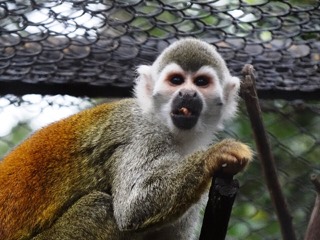 Squirrel Monkey (reference photo)

Species Data
- Classification
- Primates / Cebidae Source
- Size
- Body length about 29–32 cm, tail about 40–42 cm
- Weight
- Average about 925 g (generally ranging from about 550 g to 1.25 kg)
- Lifespan
- Wild: average about 21 years; captive: females average 27 years, males 22.7 years
- Diet
- Omnivore Fruit-leaning omnivore; eats fruit in the early morning and then forages mainly for spiders and insects. Also eats seeds, leaves, and small vertebrates such as tree frogs
- Activity
- Diurnal and arboreal, with home ranges centered on waterways
- Distribution
- The common squirrel monkey inhabits the tropical rainforests of the Amazon Basin, occurring in Brazil, Colombia, Ecuador, French Guiana, Guyana, Peru, Suriname, and Venezuela, with introduced populations in Florida and parts of the Caribbean. Source
Did You Know?
- A squirrel monkey named Gordo became the first primate launched into space in 1958, though it did not survive reentry. Source
- Their vocalizations appear to be genetically determined — even deaf squirrel monkeys have been shown to produce normal calls. Source
- Troops typically number 12 to 100 individuals, but in undisturbed forest they can occasionally swell to as many as 500. Source
Where to See This Species
Operating facilities registered on this site: Japan 12
Tobe Zoological Park of Ehime PrefectureEhimeOpened in 1988
Izu Shaboten ZooShizuokaOpened in 1959
Okazakishihigashi Kouen DoubutsuenAichiAbout 1 km toward Toyota from the Okazaki IC on the Tomei Expressway.
Osaka Aquarium KaiyukanOsakaOpened in 1990
African safariOitaBy car, the park is about 6 km (about 7 minutes) from the Beppu-wan Smart IC.
Sapporoshimaruyama DoubutsuenHokkaidoOpened in 1951
Ichikawashi DoushokubutsuenChibaAddress: 284-1 Omachi, Ichikawa, Chiba.
Hirakawa ZooKagoshimaAbout a 20-minute walk from Goino Station on the JR Ibusuki-Makurazaki Line, or take a bus bound for Taniyama / Dobutsuen from Fukuhira Nokyo-mae to the last stop.
Nagasaki Bio ParkNagasakiOpened in 1980
TOBU ZOOSaitamaFrom Tobu-Dobutsu-Koen Station (west exit), about 10 minutes on foot (600 m) or about 5 minutes by bus.
Fuji Safari ParkShizuokaOpened in 1980
Japan Monkey CentreAichiAbout a 20-minute walk from the East Exit of Meitetsu Inuyama Station (go straight along the tree-lined road for about 300 m, turn left at the Umetsubo Kosenkyo Kita intersection, and follow the road for a little over 1 km).
- 音ちゃんパイナップルお美味しいね💕 #池田動物園 #岡山 #リスザル
- ちょ、お客様…💦#東武動物公園 #リスザルの楽園 #カピバラ #リスザル# #動物 #zoo #動物園
- 9月21日~23日のイベントスケジュール
- 名物・カピバラタクシー #東武動物公園 #カピバラ #リスザル #名物 #カピバラタクシー
- とある日のリスザル 東武動物公園 公式YouTubeチャンネル
- リスザルの赤ちゃん 2026
Source links to official sites, official YouTube channels, and news aggregators such as Zoo Ring. Visit the publisher for the full item.
Conservation Story
Conservation Status
Least Concern (LC)
Sources
Support Conservation
A visit is a small, positive way to support the daily lives of the animals you care about.
- Visit
- A visit itself helps support the facility.
- Animal Supporter Programs & Giving
- Find ways to support the facility through its official website.
- Furusato Nozei
- Municipally run facilities may share official guidance for this Japanese hometown-tax program.
- Support Tobe Zoological Park of Ehime Prefecture
- Support Izu Shaboten Zoo
- Support Okazakishihigashi Kouen Doubutsuen
- Support Osaka Aquarium Kaiyukan
- Support African safari
- Support Sapporoshimaruyama Doubutsuen
- Support Ichikawashi Doushokubutsuen
- Support Hirakawa Zoo
- Support Nagasaki Bio Park
- Support TOBU ZOO
- Support Fuji Safari Park
- Support Japan Monkey Centre
FAQ
- How big are common squirrel monkeys?
- They are small primates, with a body length of roughly 29 to 32 cm plus a tail of 40 to 42 cm, and an average body mass around 925 g. Source
- What was the connection between squirrel monkeys and space travel?
- A squirrel monkey named Gordo became the first primate ever launched into space in 1958, though he did not survive the mission's reentry. Source
- Do squirrel monkeys live in large groups?
- Yes, troops usually range from 12 to 100 individuals, and in undisturbed forest habitats can occasionally reach as many as 500. Source
- How many operating facilities are registered here?
- Operating facilities registered on this site: Japan 12 Source
Books & gear
Source: ja.wikipedia.org en.wikipedia.org