Capybaraカピバラ

Hydrochoerus hydrochaerisLC— Least Concern

The capybara is the world's largest living rodent, a semiaquatic herbivore native to nearly every South American country except Chile. It lives in social groups near rivers, lakes, and wetlands, spending much of the day in water and grazing on grasses in the late afternoon and evening. With a stable population across most of its range, the IUCN lists it as Least Concern, though it is hunted for meat and pelts in some areas.
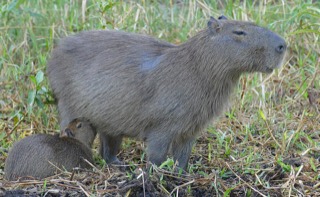
Capybara (reference photo)
Photo: Bernard DUPONT from FRANCE / CC BY-SA 2.0 / Source / cropped

Species Data

Classification
Rodentia / Caviidae Source
Size
Body length about 106–134 cm
Weight
Males about 35–64 kg, females about 37–66 kg (the largest recorded wild female weighed 91 kg)
Lifespan
In the wild, predation keeps lifespan under 4 years in many cases, but captive animals live to around 12 years (some sources put the wild average at 5–10 years)
Diet
Herbivore Herbivorous, feeding mainly on grasses in and around water; in captivity it is given hay, cabbage, apples, sweet potatoes, carrots, mulberry leaves, and similar foods
Activity
Semiaquatic; rests in the water during the day and feeds from late afternoon into the evening and night
Distribution
The capybara is native to nearly every South American country except Chile, inhabiting savannas, wetlands, and gallery forests near freshwater throughout the Amazon basin and beyond. Source

Did You Know?

  • In 1982, staff at Japan's Izu Shaboten Zoo observed a capybara relaxing in a hot spring, an incident that gave rise to the now-famous Japanese tradition of capybara hot-spring exhibits. Source
  • Within a group, females that are not the mother will sometimes nurse another female's young, reflecting the species' cooperative social structure. Source
  • Capybaras can hold their breath underwater for more than five minutes to evade predators. Source

Where to See This Species

Operating facilities registered on this site: Japan 33

Shizuoka Municipal Nihondaira ZooShizuokaOpened in 1969

Source

No.0087In residence

Nameko

なめこ

CapybaraHydrochoerus hydrochaeris

Sex
Male
Born
September 27, 2017
LC— Least Concern
No.0088In residence

Buna

ぶな

CapybaraHydrochoerus hydrochaeris

Sex
Male
Born
September 27, 2017
LC— Least Concern

Ishikawa DoubutsuenIshikawaAbout 60 minutes from the Kanazawa-Morimoto Interchange on the Hokuriku Expressway, about 40 minutes from the Kanazawa-Nishi Interchange, and about 20 minutes from the Komatsu Interchange.

Source

Saitamakenoomiya Kouen Shou DoubutsuenSaitama10 minutes on foot from Omiya-Koen Station on the Tobu Urban Park Line.

Source

Ichikawashi DoushokubutsuenChibaAddress: 284-1 Omachi, Ichikawa, Chiba.

Source

Shuunanshitokuyama DoubutsuenYamaguchiOpened in 1960

Source

Nagasaki Bio ParkNagasakiOpened in 1980

Source

TOBU ZOOSaitamaFrom Tobu-Dobutsu-Koen Station (west exit), about 10 minutes on foot (600 m) or about 5 minutes by bus.

Source

NasudoubutsuoukokuTochigiAbout 50 minutes by car from Nasu-Shiobara Station on the Tohoku Shinkansen (a free shuttle bus is available; online reservation required by 17:00 the day before).

Source

Himeji Shiritsu DoubutsuenHyogoOpened in 1951

Source

Adventure WorldWakayamaOpened in 1978

Source

Gokatsuraike Animal ParkMieAbout 10 minutes from the Seiwa-Taki Interchange.

Source

Asahiyama ZooHokkaidoOpened in 1967

Source

Izu Shaboten ZooShizuokaOpened in 1959

Source

Utsunomiya DoubutsuenTochigiAbout 5 minutes from the Utsunomiya IC on the Tohoku Expressway; free parking for 1,000 cars.

Source

Osaka Aquarium KaiyukanOsakaOpened in 1990

Source

Kiryuugaoka DoubutsuenGunmaIf driving, set your car navigation to "Kiryugaoka Amusement Park" (Kiryugaoka Yuenchi) rather than "Kiryugaoka Zoo" to reach the parking lot (searching by the zoo name may give an incorrect route).

Source

Katsurahama AquariumKochiOpened in 1931

Source

Hiroshima City Asa Zoological ParkHiroshimaFrom JR Hiroshima Station, take the Sanyo Main Line or Kabe Line to Shin-Hakushima Station, transfer to the Astram Line to Kamiyasu Station, then take a bus to "Asa Dobutsu Koen" (about 45 minutes in total).

Source

TAKAOKA KOJYO ZOOToyamaOpened in 1951

Source

Noichi Zoological Park of Kochi PrefectureKochiA 20-minute walk or 13-minute rental-bicycle ride from Noichi Station on the Tosa Kuroshio Railway Gomen-Nahari Line.

Source

Hirakawa ZooKagoshimaAbout a 20-minute walk from Goino Station on the JR Ibusuki-Makurazaki Line, or take a bus bound for Taniyama / Dobutsuen from Fukuhira Nokyo-mae to the last stop.

Source

Suzaka ZooNaganoFrom the Suzaka-Nagano-Higashi IC on the Joshin-etsu Expressway, take Route 403, turn right at the Kotaka-machi intersection, turn left at the Kami-Hatcho intersection, cross Garyu Bridge, and turn left for the south entrance.

Source

Chiba Zoological ParkChibaOpened in 1985

Source

Toba AquariumMieOpened in 1955

Source

Nasu SafariParkTochigiAbout 15 minutes from the Nasu IC or about 25 minutes from the Kuroiso-Itamuro IC on the Tohoku Expressway.

Source

Iida Shiritsu DoubutsuenNaganoAddress: 33 Ogimachi, Iida, Nagano.

Source

Hamamatsu Zoological GardensShizuokaOpened in 1950

Source

Fuji Safari ParkShizuokaOpened in 1980

Source

Former facilities

North Safari SapporoHokkaidoOpened in 2005

Source

Closed: 2025-09-30 Official Site

Keikyuuaburatsubomarin ParkKanagawaOpened in 1968

Source

Closed: 2021-09-30 Official Site

Latest news

6

Open the news index

Source links to official sites, official YouTube channels, and news aggregators such as Zoo Ring. Visit the publisher for the full item.

Conservation Story

Conservation Status

Least Concern (LC)

Sources

ja.wikipedia.org en.wikipedia.org

Support Conservation

A visit is a small, positive way to support the daily lives of the animals you care about.

Visit
A visit itself helps support the facility.
Animal Supporter Programs & Giving
Find ways to support the facility through its official website.
Furusato Nozei
Municipally run facilities may share official guidance for this Japanese hometown-tax program.

Transferred or Residency Unconfirmed

No.0070Transferred

Mitsuto

ミツト

CapybaraHydrochoerus hydrochaeris

Nagasaki Bio Park

Sex
Male
Born
October 30, 2018
LC— Least Concern
No.0071Status pending

Itachoko

イタチョコ

CapybaraHydrochoerus hydrochaeris

Saitamakenkodomodoubutsu Shizen Kouen

Sex
Male
Born
Unknown
LC— Least Concern
No.0077Status pending

Awa

あわ

CapybaraHydrochoerus hydrochaeris

Shuunanshitokuyama Doubutsuen

Sex
Female
Born
Unknown
LC— Least Concern
No.0078Status pending

Momi

モミ

CapybaraHydrochoerus hydrochaeris

TOBU ZOO

Sex
Unknown
Born
August 31, 2023
LC— Least Concern
No.0079Status pending

Muku

ムク

CapybaraHydrochoerus hydrochaeris

TOBU ZOO

Sex
Unknown
Born
September 6, 2023
LC— Least Concern
No.0080Status pending

Nemu

ネム

CapybaraHydrochoerus hydrochaeris

TOBU ZOO

Sex
Unknown
Born
September 6, 2023
LC— Least Concern
No.0081Status pending

Shita

シータ

CapybaraHydrochoerus hydrochaeris

Ishikawa Doubutsuen

Sex
Female
Born
July 16, 2016
LC— Least Concern
No.0089Status pending

Chanko

ちゃんこ

CapybaraHydrochoerus hydrochaeris

Shizuoka Municipal Nihondaira Zoo

Sex
Male
Born
April 23, 2018
LC— Least Concern
No.0090Status pending

Sakura

さくら

CapybaraHydrochoerus hydrochaeris

Shizuoka Municipal Nihondaira Zoo

Sex
Male
Born
December 3, 2018
LC— Least Concern

Individuals Remembered

No.0069In memoriam

Kokone

心音

CapybaraHydrochoerus hydrochaeris

Saitamakenkodomodoubutsu Shizen Kouen

Sex
Female
Born
Unknown
LC— Least Concern
No.0072In memoriam

Botan

ぼたん

CapybaraHydrochoerus hydrochaeris

Nasudoubutsuoukoku

Sex
Female
Born
August 21, 2022
LC— Least Concern
No.0073In memoriam

Koharu

こはる

CapybaraHydrochoerus hydrochaeris

Nasudoubutsuoukoku

Sex
Female
Born
March 18, 2017
LC— Least Concern
No.0074In memoriam

Cherry

チェリー

CapybaraHydrochoerus hydrochaeris

Saitamakenoomiya Kouen Shou Doubutsuen

Sex
Female
Born
June 15, 2014
LC— Least Concern
No.0075In memoriam

Peace

ピース

CapybaraHydrochoerus hydrochaeris

Saitamakenoomiya Kouen Shou Doubutsuen

Sex
Male
Born
Unknown
LC— Least Concern
No.0076In memoriam

Sawa

サワ

CapybaraHydrochoerus hydrochaeris

Shuunanshitokuyama Doubutsuen

Sex
Male
Born
March 29, 2017
LC— Least Concern
No.0082In memoriam

Satchi

サッチ

CapybaraHydrochoerus hydrochaeris

Ishikawa Doubutsuen

Sex
Female
Born
May 2011
LC— Least Concern
No.0083In memoriam

Rerako

レラコ

CapybaraHydrochoerus hydrochaeris

Higashiyama Zoo and Botanical Gardens

Sex
Female
Born
October 19, 2021
LC— Least Concern
No.0084In memoriam

Omochi

オモチ

CapybaraHydrochoerus hydrochaeris

Himeji Shiritsu Doubutsuen

Sex
Female
Born
Unknown
LC— Least Concern
No.0085In memoriam

Ain

アイン

CapybaraHydrochoerus hydrochaeris

Ichikawashi Doushokubutsuen

Sex
Female
Born
around 2010
LC— Least Concern
No.0086In memoriam

Kizuna

キズナ

CapybaraHydrochoerus hydrochaeris

Yokohama Shiritsu Kanazawa Doubutsuen

Sex
Male
Born
August 9, 2010
LC— Least Concern

FAQ

How big is a capybara?
Capybaras are the largest living rodents, measuring about 106 to 134 cm in body length and typically weighing 35 to 66 kg, with the heaviest wild female on record reaching 91 kg. Source
Why do capybaras like water so much?
They are semiaquatic animals that rest in water during the heat of the day, can hold their breath for more than five minutes to escape predators, and rely on wetland habitats for food and safety. Source
Are capybaras endangered?
No. The IUCN classifies capybaras as Least Concern, and their population remains stable across most of their South American range, though they are hunted in some areas for meat and pelts. Source
How many operating facilities are registered here?
Operating facilities registered on this site: Japan 33 Source

Books & gear

Source: www.iucnredlist.org izushaboten.com www.city.suzaka.nagano.jp www.parks.or.jp