Common Ostrichダチョウ

Struthio camelusLC— Least Concern

The common ostrich is the largest living bird, native to the savannas and Sahel regions of Africa, where males can stand up to 2.75 meters tall. Flightless but built for speed, it can run at more than 70 km/h, making it the fastest bipedal animal on Earth. A herbivore that also produces the largest eggs of any living bird, it is farmed worldwide for meat, leather, and feathers.

Operating facilities registered on this site: Japan 16 · Overseas 1 (Morioka Zoo, Sapporo Maruyama Zoo, Hirakawa Zoo, and 13 more). These facilities are confirmed by resident animal records or the facility’s official information.
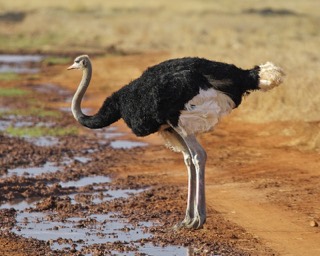
Common Ostrich (reference photo)
Photo: Lip Kee from Singapore, Republic of Singapore / CC BY-SA 2.0 / Source / cropped

Species Data

Classification
Struthioniformes / Struthionidae Source
Size
Height: males 2.1–2.75 m / females 1.75–1.9 m (the largest living bird)
Weight
Males 100–130 kg / females 90–120 kg
Lifespan
Average lifespan 50–60 years; one captive bird lived to 62 years 7 months
Diet
Herbivore Herbivorous, feeding mainly on leaves, roots, and seeds, and occasionally on insects, small reptiles, and rodents; ferments plant fiber in its gut as an energy source
Distribution
Native to African savanna and Sahel regions; feral populations now exist in Australia following escapes from ostrich farms. Source

Did You Know?

  • Ostrich eggs are the largest of all bird eggs, weighing approximately 1.4 kg. Source
  • Ostriches can run at speeds exceeding 70 km/h, making them the fastest bipedal animals. Source
  • Only about 15% of hatchlings survive to one year old due to predation. Source

Where to See This Species

Operating facilities registered on this site: Japan 16 · Overseas 1

Morioka ZooIwateOpened in 1989

Source

No.0188In residence

Dachomi

だちょみ

Common OstrichStruthio camelus

Sex
Female
Born
Unknown
LC— Least Concern
No.0189In residence

Dachopa

だちょぱ

Common OstrichStruthio camelus

Sex
Female
Born
Unknown
LC— Least Concern

Sapporo Maruyama ZooHokkaidoOpened in 1951

Source

Hirakawa ZooKagoshimaAbout a 20-minute walk from Goino Station on the JR Ibusuki-Makurazaki Line, or take a bus bound for Taniyama / Dobutsuen from Fukuhira Nokyo-mae to the last stop.

Source

Chiba Zoological ParkChibaOpened in 1985

Source

Hamamatsu Zoological GardensShizuokaOpened in 1950

Source

Asahiyama ZooHokkaidoOpened in 1967

Source

Akiyoshidai Safari LandYamaguchiOpened in 1978

Source

Hiroshima City Asa Zoological ParkHiroshimaFrom JR Hiroshima Station, take the Sanyo Main Line or Kabe Line to Shin-Hakushima Station, transfer to the Astram Line to Kamiyasu Station, then take a bus to "Asa Dobutsu Koen" (about 45 minutes in total).

Source

Fukuyama City ZooHiroshimaThere is no public transportation; access is by car.

Source

HIMEJI CENTRAL PARKHyogoFrom the north exit of JR Himeji Station, take the Shinki Bus bound for Himeji Central Park (fare: adults ¥590, children ¥300).

Source

Izu Animal KingdomShizuokaOpened in 1977

Source

Kurume City Bird CenterFukuokaLocated at 1667 Higashi-Kushihara-machi, Kurume, Fukuoka, inside Chuo Park.

Source

Neo Park OkinawaOkinawaAbout 15 minutes by car from the Kyoda Interchange on the Okinawa Expressway.

Source

Sendai Yagiyama Zoological ParkMiyagiTake the Sendai Subway Tozai Line to Yagiyama Zoological Park Station; the zoo is right by the elevator from Central Exit 1 (about 12 minutes from Sendai Station).

Source

Nonhoi ParkAichiAbout a 6-minute walk from the South Exit of Futagawa Station on the JR Tokaido Main Line.

Source

Cincinnati Zoo & Botanical GardenOpened in 1875

No.0800In residence

Myrtle

Myrtle

Common OstrichStruthio camelus

Sex
Female
Born
Unknown
LC— Least Concern
Possible records, not yet confirmed: 8

These facilities are not confirmed by an official animal list. They appear in secondary sources such as Wikipedia; check the facility’s official website for current exhibits.

Adventure WorldWakayamaOpened in 1978

(Not confirmed by official sources) Source

Iwate SafariParkIwateAbout 45 minutes from the Ichinoseki IC, about 30 minutes from the Wakayanagi-Kannari IC, or about 25 minutes via National Route 284.

(Not confirmed by official sources) Source

Miyazaki City Phoenix ZooMiyazakiBuses bound for Phoenix Shizen Dobutsuen run from Miyako City or Miyazaki Station (check the Miyazaki Kotsu website for detailed timetables).

(Not confirmed by official sources) Source

IKEDA ZOOOkayamaFrom the West Exit of JR Okayama Station, take an Okaden Bus bound for Chuo Byoin (Central Hospital) to the Kyoyama Iriguchi stop, then walk about 12 minutes.

(Not confirmed by official sources) Source

Nagasaki Bio ParkNagasakiOpened in 1980

(Not confirmed by official sources) Source

Ueno ZooTokyoOpened in 1882

(Not confirmed by official sources) Source

Nasu SafariParkTochigiAbout 15 minutes from the Nasu IC or about 25 minutes from the Kuroiso-Itamuro IC on the Tohoku Expressway.

(Not confirmed by official sources) Source

Himeji City ZooHyogoOpened in 1951

(Not confirmed by official sources) Source

Former facilities

North Safari SapporoHokkaidoOpened in 2005

(Not confirmed by official sources) Source

Closed: 2025-09-30 Official Site

Latest news

6

Open the news index

Source links to official sites, official YouTube channels, and news aggregators such as Zoo Ring. Visit the publisher for the full item.

Conservation Story

Conservation Status

Least Concern (LC)

Sources

ja.wikipedia.org

Support Conservation

A visit is a small, positive way to support the daily lives of the animals you care about.

Visit
A visit itself helps support the facility.
Animal Supporter Programs & Giving
Find ways to support the facility through its official website.
Furusato Nozei
Municipally run facilities may share official guidance for this Japanese hometown-tax program.

FAQ

Where can I see Common Ostrich in Japan?
Operating facilities registered on this site: Japan 16 · Overseas 1 (Morioka Zoo, Sapporo Maruyama Zoo, Hirakawa Zoo, and 13 more). These facilities are confirmed by resident animal records or the facility’s official information. Source
How fast can an ostrich run?
It can run at speeds exceeding 70 km/h, making it the fastest bipedal animal. Source
How big are ostrich eggs?
Ostrich eggs are the largest of all bird eggs, weighing about 1.4 kg—roughly 25 times the weight of a chicken egg. Source
How long do ostriches live?
Their average lifespan is 50–60 years, and captive individuals have lived as long as 62 years and 7 months, among the longest-lived of all birds. Source

Books & gear

Source: ja.wikipedia.org en.wikipedia.org