Tsushima Leopard Catツシマヤマネコ

Prionailurus bengalensis euptilurusLC— Least Concern

The Tsushima leopard cat is a subspecies of leopard cat found only on Tsushima Island, Japan, isolated from the mainland Asian population for thousands of years. It hunts small mammals, birds, and fish at night and often frequents rice paddies near forest edges. With an estimated population of only around 70 to 100 individuals, it is listed as Critically Endangered on Japan's Red List.

Operating facilities registered on this site: Japan 7 (Toyama Municipal Family Park Zoo, Fukuoka Zoo & Botanical Garden, Zoorasia, and 4 more). These facilities are confirmed by resident animal records or the facility’s official information.
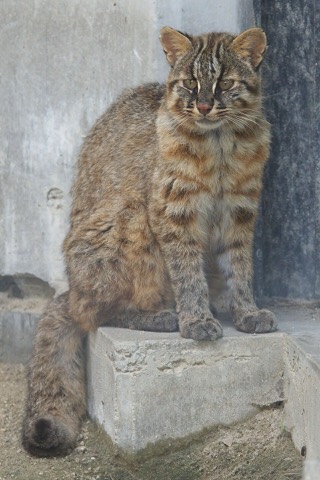
Tsushima Leopard Cat (reference photo)
Photo: Pontafon / CC BY-SA 3.0 / Source / cropped

Species Data

Classification
Carnivora / Felidae Source
Size
Body length about 50–80 cm
Weight
About 3–5 kg
Lifespan
Wild: about 8–10 years
Diet
Carnivore Carnivorous, eating small mammals, birds, and fish; hunts mainly rodents around farmland
Activity
Nocturnal; during the breeding season it is often seen around rice paddies while protecting its young
Distribution
The Tsushima leopard cat, a subspecies of the leopard cat found only on Tsushima Island in Nagasaki Prefecture, Japan, was estimated at roughly 70 to 100 individuals in a 2010–2012 survey. Source

Did You Know?

  • It has white spots on the backs of its ears, a feature shared with the broader leopard cat species to which it belongs. Source
  • Since being listed as Critically Endangered on Japan's Red List in 1998, human-caused mortality such as vehicle collisions has been a major factor in the subspecies' decline. Source
  • A canal crossing Tsushima Island has split the population into northern and southern groups, raising concerns about reduced genetic diversity. Source

Where to See This Species

Operating facilities registered on this site: Japan 7

Toyama Municipal Family Park ZooToyamaOpened in 1984

Source

No.0052In residence

Aoba

あおば

Tsushima Leopard CatPrionailurus bengalensis euptilurus

Sex
Male
Born
May 4, 2018
LC— Least Concern
No.0688In residence

Mei

メイ

Tsushima Leopard CatPrionailurus bengalensis euptilurus

Sex
Female
Born
April 11, 2014
LC— Least Concern

Fukuoka Zoo & Botanical GardenFukuokaOpened in 1953

Source

No.0180In residence

Choko

チョコ

Tsushima Leopard CatPrionailurus bengalensis euptilurus

Sex
Female
Born
July 6, 2022
LC— Least Concern
No.0360In residence

Hime

妃

Tsushima Leopard CatPrionailurus bengalensis euptilurus

Sex
Female
Born
Unknown
LC— Least Concern
No.0417In residence

Jimmy

ジミー

Tsushima Leopard CatPrionailurus bengalensis euptilurus

Sex
Male
Born
Unknown
LC— Least Concern

ZoorasiaKanagawaOpened in 1999

Source

Kyoto City ZooKyotoOpened in 1903

Source

Inokashira Park ZooTokyoOpened in 1942

Source

Nasu Animal KingdomTochigiAbout 50 minutes by car from Nasu-Shiobara Station on the Tohoku Shinkansen (a free shuttle bus is available; online reservation required by 17:00 the day before).

Source

Possible records, not yet confirmed: 4

These facilities are not confirmed by an official animal list. They appear in secondary sources such as Wikipedia; check the facility’s official website for current exhibits.

Saikai National Park Kujukushima Zoo & Botanical GardenNagasakiOpened in 1961

(Not confirmed by official sources) Source

Okinawa Zoo & MuseumOkinawaOpened in 1970

(Not confirmed by official sources) Source

Kumamoto City Zoological and Botanical GardensKumamotoTake the tram bound for Kengun and get off at the Doshokubutsuen-Iriguchi stop, then walk 10 minutes.

(Not confirmed by official sources) Source

Morioka ZooIwateOpened in 1989

(Not confirmed by official sources) Source

Latest news

6

Open the news index

Source links to official sites, official YouTube channels, and news aggregators such as Zoo Ring. Visit the publisher for the full item.

Conservation Story

Conservation Status

Least Concern (LC)

Sources

ja.wikipedia.org en.wikipedia.org

Support Conservation

A visit is a small, positive way to support the daily lives of the animals you care about.

Visit
A visit itself helps support the facility.
Animal Supporter Programs & Giving
Find ways to support the facility through its official website.
Furusato Nozei
Municipally run facilities may share official guidance for this Japanese hometown-tax program.

FAQ

Where can I see Tsushima Leopard Cat in Japan?
Operating facilities registered on this site: Japan 7 (Toyama Municipal Family Park Zoo, Fukuoka Zoo & Botanical Garden, Zoorasia, and 4 more). These facilities are confirmed by resident animal records or the facility’s official information. Source
Where does the Tsushima leopard cat live?
It is found only on Tsushima Island in Nagasaki Prefecture, Japan, and nowhere else in the wild. Source
How many Tsushima leopard cats remain in the wild?
A 2010–2012 survey estimated the wild population at roughly 70 to 100 individuals, and it is listed as Critically Endangered on Japan's Red List. Source
What is the biggest threat to Tsushima leopard cats?
Vehicle collisions are a major cause of death, and a canal dividing the island has split the population into two genetically isolated groups. Source

Books & gear

Source: ja.wikipedia.org en.wikipedia.org