Japanese Fire Belly Newtアカハライモリ
Cynops pyrrhogasterNT— Near Threatened
The Japanese fire-bellied newt is a small salamander endemic to Japan, easily recognized by its dark back and vivid red-and-black mottled underside. It is famous for extraordinary regenerative powers, capable of regrowing an entire severed limb with functional joints or fully rebuilding a lost tail down to the bone. Wild individuals also accumulate the potent neurotoxin tetrodotoxin, primarily through their diet, and the species has even flown aboard the Space Shuttle for microgravity reproduction experiments in 1994.
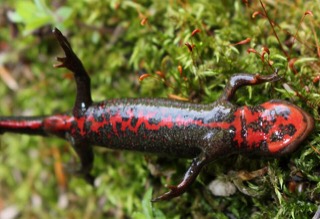 Japanese Fire Belly Newt (reference photo)
.jpg)
Species Data
- Classification
- Urodela (Caudata) / Salamandridae Source
- Size
- Total length 8–15 cm
- Lifespan
- Average 10–20 years; a 23-year-old individual has been confirmed in the wild, and some captive individuals live over 40 years
- Diet
- Carnivore Carnivorous; juveniles eat soil animals such as springtails, mites, land snails, and earthworms, while adults prey on a variety of insects including dragonflies, flies, wasps, and beetles. It sometimes eats the eggs of its own species
- Distribution
- Endemic to Japan, found on Honshu (south of Mutsu in Aomori Prefecture), Shikoku, and Kyushu, inhabiting forests, grasslands, wetlands, and man-made ponds from 30 to 2,020 m elevation. Source
- Sources
- ja.wikipedia.org en.wikipedia.org
Did You Know?
- It possesses extraordinary regenerative abilities, fully regrowing a severed tail down to the bone and even regenerating an entire limb, including functional joints, if cut off at the shoulder. Source
- Wild individuals carry high levels of the neurotoxin tetrodotoxin, but the toxin is thought to be acquired almost entirely through diet rather than produced by the newt itself. Source
- In 1994, individuals of this species flew aboard the Space Shuttle Columbia alongside Japanese astronaut Chiaki Mukai for experiments observing egg-laying and development under microgravity. Source
Where to See This Species
Operating facilities registered on this site: Japan 5
Wan Park Kouchianimaru LandKochiAddress: 6-9-1 Sanbashi-dori, Kochi (inside Wanpark Kochi).
Kyoto City ZooKyotoOpened in 1903
Kiryuugaoka DoubutsuenGunmaIf driving, set your car navigation to "Kiryugaoka Amusement Park" (Kiryugaoka Yuenchi) rather than "Kiryugaoka Zoo" to reach the parking lot (searching by the zoo name may give an incorrect route).
Iida Shiritsu DoubutsuenNaganoAddress: 33 Ogimachi, Iida, Nagano.
Higashiyama Zoo and Botanical GardensAichiOpened in 1937
- 【81%】鳥羽水族館で「驚異の天気予報正解率をたたき出した7月のあの生き物」他 本日の注目情報セレクション
- 【キュレーターブログ】アカハライモリの赤ちゃん摂餌シーン
- 【キュレーターブログ】アカハライモリのおとな摂餌シーン
- シマサトミさんによる『御当地井守(滋賀)』他入荷!!
Source links to official sites, official YouTube channels, and news aggregators such as Zoo Ring. Visit the publisher for the full item.
Conservation Story
Conservation Status
Near Threatened (NT)
Sources
Support Conservation
A visit is a small, positive way to support the daily lives of the animals you care about.
- Visit
- A visit itself helps support the facility.
- Animal Supporter Programs & Giving
- Find ways to support the facility through its official website.
- Furusato Nozei
- Municipally run facilities may share official guidance for this Japanese hometown-tax program.
FAQ
- What makes the Japanese fire-bellied newt scientifically notable?
- It has extraordinary regenerative abilities, able to fully regrow a severed tail down to the bone or regenerate an entire limb with functional joints, making it an important model organism for regeneration research. Source
- Is the Japanese fire-bellied newt poisonous?
- Wild individuals carry high levels of the neurotoxin tetrodotoxin, though this toxin appears to be acquired mainly through diet rather than produced by the newt's own body. Source
- Has this species been used in space research?
- Yes—in 1994, Japanese fire-bellied newts flew aboard the Space Shuttle Columbia with astronaut Chiaki Mukai for experiments studying egg-laying and embryonic development under microgravity. Source
- How many operating facilities are registered here?
- Operating facilities registered on this site: Japan 5 Source
Books & gear
Source: ja.wikipedia.org en.wikipedia.org