Red Kangarooアカカンガルー
Osphranter rufusLC— Least Concern
The red kangaroo is the largest living marsupial and one of Australia's most iconic animals, roaming the continent's arid grasslands and deserts in mobs led by a dominant male. A grazing herbivore active mainly at dawn, dusk, and night, it can bound at up to 60 km/h and cover several meters in a single leap. Classified as Least Concern, it remains widespread and abundant across mainland Australia.
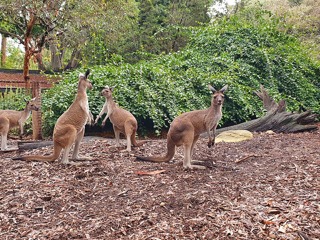 Red Kangaroo (reference photo)

Species Data
- Classification
- Diprotodontia / Macropodidae Source
- Size
- Males: body length 130–160 cm, tail 100–120 cm; females: body length 85–105 cm, tail 65–85 cm
- Weight
- Males 55–90 kg, females 18–40 kg
- Lifespan
- A wild individual has been recorded surviving 22 years
- Diet
- Herbivore Herbivorous, feeding mainly on fresh grasses, broad-leaved herbs, and flowering plants (green grass makes up 75–95% of the diet); in the dry season it practices pseudo-rumination, regurgitating swallowed food to chew it again
- Activity
- Mainly crepuscular and nocturnal; rests in the shade during the day
- Distribution
- Found across most of mainland Australia, but absent from the fertile southwest, the eastern and southeastern coasts, and the northern rainforests. It favors arid grasslands and deserts with less than 500 mm of annual rainfall. Source
- Sources
- ja.wikipedia.org en.wikipedia.org
Did You Know?
- Males can weigh up to 90 kg, making the red kangaroo the largest living marsupial. They can bound at speeds of up to 60 km/h. Source
- To cope with heat, red kangaroos lick their forearms to wet them with saliva, using evaporative cooling as a distinctive thermoregulation behavior. Source
- Gestation lasts only about 33 days, and the newborn joey—weighing under 1 gram at birth—must climb unaided into its mother's pouch to continue developing. Source
Where to See This Species
Operating facilities registered on this site: Japan 14
Adventure WorldWakayamaOpened in 1978
Tobe Zoological Park of Ehime PrefectureEhimeOpened in 1988
Yokohama Shiritsu Yokohama DoubutsuenKanagawaOpened in 1999
Yokohama Shiritsu Nogeyama DoubutsuenKanagawaOpened in 1951
African safariOitaBy car, the park is about 6 km (about 7 minutes) from the Beppu-wan Smart IC.
Kumamotoshi DoushokubutsuenKumamotoTake the tram bound for Kengun and get off at the Doshokubutsuen-Iriguchi stop, then walk 10 minutes.
Sapporoshimaruyama DoubutsuenHokkaidoOpened in 1951
Hirakawa ZooKagoshimaAbout a 20-minute walk from Goino Station on the JR Ibusuki-Makurazaki Line, or take a bus bound for Taniyama / Dobutsuen from Fukuhira Nokyo-mae to the last stop.
Suzaka ZooNaganoFrom the Suzaka-Nagano-Higashi IC on the Joshin-etsu Expressway, take Route 403, turn right at the Kotaka-machi intersection, turn left at the Kami-Hatcho intersection, cross Garyu Bridge, and turn left for the south entrance.
TOBU ZOOSaitamaFrom Tobu-Dobutsu-Koen Station (west exit), about 10 minutes on foot (600 m) or about 5 minutes by bus.
Himeji Shiritsu DoubutsuenHyogoOpened in 1951
Fuji Safari ParkShizuokaOpened in 1980
Fukuoka Zoo & Botanical GardenFukuokaOpened in 1953
Higashiyama Zoo and Botanical GardensAichiOpened in 1937
Former facilities
North Safari SapporoHokkaidoOpened in 2005
Closed: 2025-09-30 Official Site
Source links to official sites, official YouTube channels, and news aggregators such as Zoo Ring. Visit the publisher for the full item.
Conservation Story
Conservation Status
Least Concern (LC)
Sources
Support Conservation
A visit is a small, positive way to support the daily lives of the animals you care about.
- Visit
- A visit itself helps support the facility.
- Animal Supporter Programs & Giving
- Find ways to support the facility through its official website.
- Furusato Nozei
- Municipally run facilities may share official guidance for this Japanese hometown-tax program.
- Support Adventure World
- Support Tobe Zoological Park of Ehime Prefecture
- Support Yokohama Shiritsu Yokohama Doubutsuen
- Support Yokohama Shiritsu Nogeyama Doubutsuen
- Support African safari
- Support Kumamotoshi Doushokubutsuen
- Support Sapporoshimaruyama Doubutsuen
- Support Hirakawa Zoo
- Support Suzaka Zoo
- Support TOBU ZOO
- Support Himeji Shiritsu Doubutsuen
- Support Fuji Safari Park
- Support Fukuoka Zoo & Botanical Garden
- Support Higashiyama Zoo and Botanical Gardens
FAQ
- How big do red kangaroos get?
- Males are considerably larger than females, reaching up to 1.6 m in body length and 90 kg in weight, making the red kangaroo the largest living marsupial. Females typically weigh 18–40 kg. Source
- How fast can a red kangaroo move?
- Red kangaroos can bound at speeds of up to 60 km/h, with males capable of leaps spanning 8–9 meters and reaching heights of nearly 3 meters when pressed. Source
- How do red kangaroos raise their young?
- After a gestation of only about 33 days, the tiny, underdeveloped joey—less than 1 gram at birth—crawls unassisted into its mother's pouch, where it continues developing while attached to a teat. Source
- How many operating facilities are registered here?
- Operating facilities registered on this site: Japan 14 Source
Books & gear
Source: ja.wikipedia.org en.wikipedia.org