Spotted Sealゴマフアザラシ
Phoca larghaLC— Least Concern
The spotted seal is a pinniped of the North Pacific and adjacent seas, ranging from the Bering and Chukchi Seas south to the Sea of Japan and Yellow Sea. It gives birth on drifting pack ice, and its white-coated pups rely on this ice for camouflage and shelter. While the IUCN lists the species overall as Least Concern, the southern population near the Yellow Sea and Bohai Sea is considered more threatened.
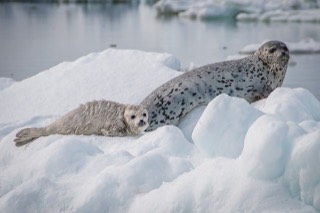 Spotted Seal (reference photo)

Species Data
- Classification
- Carnivora / Phocidae Source
- Size
- Males about 170 cm / females about 160 cm
- Weight
- About 70–130 kg
- Lifespan
- Wild: estimated 30–35 years / captive: one individual, "Tenyo 1," lived 47 years
- Diet
- Piscivore Small fish such as walleye pollock, flounder, saury, herring, and capelin, as well as cephalopods and crustaceans
- Distribution
- The spotted seal inhabits the Bering, Chukchi, and Okhotsk Seas, the Sea of Japan, and the Bohai and Yellow Seas; in Japan it is found along the coasts of eastern and northern Hokkaido. Source
- Sources
- ja.wikipedia.org en.wikipedia.org
Did You Know?
- Pups are born on drifting sea ice and are covered in white lanugo fur, which provides camouflage against the ice. Source
- The Yellow Sea population is known to migrate more than 3,300 kilometers each year. Source
- The character "Goma-chan" from the manga Shonen Ashibe, first serialized in 1988, is modeled on this species and greatly boosted its popularity in Japan. Source
Where to See This Species
Operating facilities registered on this site: Japan 28
Otaru AquariumHokkaidoOpened in 1958
Toba AquariumMieOpened in 1955
Kagoshima City AquariumKagoshimaFrom Kagoshima-Chuo Station, take the tram (Route 2) to the Suizokukan-guchi stop and walk 8 minutes.
Aqua World Ibaraki Prefecture Oarai AquariumIbarakiAddress: 8252-3 Isohama-cho, Oarai-machi, Higashiibaraki-gun, Ibaraki Prefecture.
Adventure WorldWakayamaOpened in 1978
Awashima Marine ParkShizuokaOpened in 1963
Ishikawa DoubutsuenIshikawaAbout 60 minutes from the Kanazawa-Morimoto Interchange on the Hokuriku Expressway, about 40 minutes from the Kanazawa-Nishi Interchange, and about 20 minutes from the Komatsu Interchange.
NOTOJIMA AQUARIUMIshikawaThe nearest station is Wakura-Onsen Station.
Aquamarine FukushimaFukushimaOpened in 2000
Maxell Aqua Park ShinagawaTokyoAbout a 2-minute walk from the Takanawa exit of Shinagawa Station (Shinkansen, JR, and Keikyu lines).
MARINE WORLD uminonakamichiFukuokaFrom JR Hakata Station, take the Kagoshima Main Line 11 minutes to Kashii Station, transfer to the JR Kashii Line (bound for Saitozaki), and ride 20 minutes to Uminonakamichi Station.
Asahiyama ZooHokkaidoOpened in 1967
Echizen Matsushima AquariumFukuiOpened in 1959
Shimoda AquariumShizuokaOpened in 1967
Osaka Aquarium KaiyukanOsakaOpened in 1990
Kamogawa Sea WorldChibaAbout 2 hours from Tokyo Station on the Wakashio limited express to JR Awa-Kamogawa Station, then about 10 minutes by free shuttle bus (departing from the West Exit bus stop).
Miyajima Public AquariumHiroshimaOpened in 2011
Kyoto AquariumKyotoAbout a 15-minute walk from the central exit of JR Kyoto Station.
Sapporoshimaruyama DoubutsuenHokkaidoOpened in 1951
Kinosaki Marine WorldHyogoAbout 10 minutes by Zentan Bus from JR Kinosaki-Onsen Station; get off at the Hiyoriyama (Marine World) bus stop.
Shinsapporosanpiaza SuizokukanHokkaidoAbout a 5-minute walk from Shin-Sapporo Station on the Sapporo Municipal Subway Tozai Line, or about a 3-minute walk from Shin-Sapporo Station on the JR Chitose Line.
ENOSHIMA AQUARIUMKanagawaOpened in 2004
Kobe Suma Sea WorldHyogoOpened in 2024
WAKKANAI NOSHAPPU AQUARIUMHokkaidoOpened in 1968
TOBU ZOOSaitamaFrom Tobu-Dobutsu-Koen Station (west exit), about 10 minutes on foot (600 m) or about 5 minutes by bus.
Port of Nagoya Public AquariumAichi5 minutes on foot from Exit 3 of Nagoyako Station on the Subway Meiko Line (transfer to the Meiko Line at Sakae Station on the Higashiyama Line, or at Kanayama Station on the Meitetsu and JR lines).
Higashiyama Zoo and Botanical GardensAichiOpened in 1937
Former facilities
North Safari SapporoHokkaidoOpened in 2005
Closed: 2025-09-30 Official Site
Keikyuuaburatsubomarin ParkKanagawaOpened in 1968
Closed: 2021-09-30 Official Site
Closed: 2018-01-31 Official Site
- 加茂ゴマフアザラシ #ゴマフアザラシ #shorts
- 【アザラシ】敬老の日...ゴマフアザラシのおじいさん(伊勢シーパラダイス/水族館)
- 【現実】伊勢シーパラダイスで「敬老の日にちなんで高齢動物にありがちな真剣な話」他 本日の注目情報セレクション
- 今日も一日お疲れさまでした🍃※音量注意 #ゴマフアザラシ #shorts #加茂水族館
- 【東山動植物園公式】今朝の様子《 ペンギン カリフォルニアアシカ ゴマフアザラシ 》#shorts
- なにかを見つめています❤ #ゴマフアザラシ #加茂水族館 #shorts
Source links to official sites, official YouTube channels, and news aggregators such as Zoo Ring. Visit the publisher for the full item.
Conservation Story
Conservation Status
Least Concern (LC)
Sources
Support Conservation
A visit is a small, positive way to support the daily lives of the animals you care about.
- Visit
- A visit itself helps support the facility.
- Animal Supporter Programs & Giving
- Find ways to support the facility through its official website.
- Furusato Nozei
- Municipally run facilities may share official guidance for this Japanese hometown-tax program.
- Support Otaru Aquarium
- Support Toba Aquarium
- Support Kagoshima City Aquarium
- Support Aqua World Ibaraki Prefecture Oarai Aquarium
- Support Adventure World
- Support Awashima Marine Park
- Support Ishikawa Doubutsuen
- Support Susami Chouritsu Ebitokanino Suizokukan
- Support NOTOJIMA AQUARIUM
- Support Aquamarine Fukushima
- Support Maxell Aqua Park Shinagawa
- Support MARINE WORLD uminonakamichi
- Support Asahiyama Zoo
- Support Echizen Matsushima Aquarium
- Support Shimoda Aquarium
- Support Osaka Aquarium Kaiyukan
- Support Kamogawa Sea World
- Support Miyajima Public Aquarium
- Support Kyoto Aquarium
- Support Sapporoshimaruyama Doubutsuen
- Support Kinosaki Marine World
- Support Shinsapporosanpiaza Suizokukan
- Support ENOSHIMA AQUARIUM
- Support Kobe Suma Sea World
- Support WAKKANAI NOSHAPPU AQUARIUM
- Support TOBU ZOO
- Support Port of Nagoya Public Aquarium
- Support Higashiyama Zoo and Botanical Gardens
FAQ
- Where do spotted seals give birth?
- They give birth on drifting sea ice, and their pups are born with white lanugo fur that camouflages them against the ice. Source
- Are spotted seals endangered?
- The species as a whole is listed as Least Concern by the IUCN, but the smaller southern population around the Yellow Sea and Bohai Sea faces greater threats and stricter protection. Source
- What do spotted seals eat?
- Adults feed on fish such as herring, pollock, and capelin, along with squid and crustaceans, while young seals rely more on krill and small crustaceans. Source
- How many operating facilities are registered here?
- Operating facilities registered on this site: Japan 28 Source
Books & gear
Source: otaru-aq.jp aquarium.co.jp ioworld.jp www.iucnredlist.org