Raccoon Dogタヌキ
Nyctereutes procyonoidesLC— Least Concern
The raccoon dog is an East Asian canid named for its raccoon-like facial markings, though it is not closely related to true raccoons. An adaptable omnivore, it is the only canid known to enter a hibernation-like torpor in winter after building up substantial fat reserves. Introduced to Europe for fur farming in the early 20th century, it has since become an established, and in some regions invasive, part of the continent's wildlife.
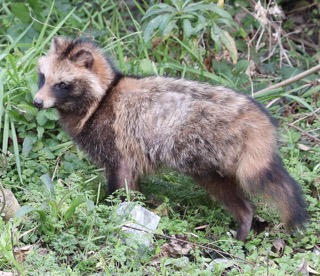 Raccoon Dog (reference photo)

Species Data
- Classification
- Carnivora / Canidae Source
- Size
- Head-body length 50–68 cm, tail 12.5–25 cm
- Weight
- 4–6 kg (rising to 6–10 kg in fall)
- Lifespan
- Wild: about 6–7 years / captive: record of 11 years
- Diet
- Omnivore Omnivorous, eating rodents, birds and their eggs, amphibians, fish, insects, myriapods, crustaceans, mollusks, and carrion, along with a wide range of plant matter such as leaves, buds, fruit, nuts, and seeds
- Activity
- Mainly nocturnal, but also active by day in areas with little human disturbance
- Distribution
- Native to East Asia, including Japan, the Korean Peninsula, China, the Russian Far East, Mongolia, and Vietnam. Introduced to Europe for the fur trade from 1928 onward, it is now established in Finland, Germany, France, and other countries. Source
- Sources
- ja.wikipedia.org en.wikipedia.org
Did You Know?
- Raccoon dogs have a communal latrine habit in which multiple individuals repeatedly defecate at the same spots; a single animal's home range typically contains about ten such latrine sites. Source
- Uniquely among canids, raccoon dogs enter a hibernation-like torpor in winter, increasing their body fat by 18–23% beforehand and lowering their metabolism by about 25%. Source
- When startled by a loud stimulus such as a gunshot, raccoon dogs can enter a death-feigning state, a behavior widely believed to be the origin of the Japanese expression "tanuki-neiri" (playing possum). Source
Where to See This Species
Operating facilities registered on this site: Japan 6
Kiryuugaoka DoubutsuenGunmaIf driving, set your car navigation to "Kiryugaoka Amusement Park" (Kiryugaoka Yuenchi) rather than "Kiryugaoka Zoo" to reach the parking lot (searching by the zoo name may give an incorrect route).
Sapporoshimaruyama DoubutsuenHokkaidoOpened in 1951
Ichikawashi DoushokubutsuenChibaAddress: 284-1 Omachi, Ichikawa, Chiba.
Hirakawa ZooKagoshimaAbout a 20-minute walk from Goino Station on the JR Ibusuki-Makurazaki Line, or take a bus bound for Taniyama / Dobutsuen from Fukuhira Nokyo-mae to the last stop.
Sendaishiyagiyama Doubutsu KouenMiyagiTake the Sendai Subway Tozai Line to Yagiyama Zoological Park Station; the zoo is right by the elevator from Central Exit 1 (about 12 minutes from Sendai Station).
Himeji Shiritsu DoubutsuenHyogoOpened in 1951
Source links to official sites, official YouTube channels, and news aggregators such as Zoo Ring. Visit the publisher for the full item.
Conservation Story
Conservation Status
Least Concern (LC)
Sources
Support Conservation
A visit is a small, positive way to support the daily lives of the animals you care about.
- Visit
- A visit itself helps support the facility.
- Animal Supporter Programs & Giving
- Find ways to support the facility through its official website.
- Furusato Nozei
- Municipally run facilities may share official guidance for this Japanese hometown-tax program.
FAQ
- Is the raccoon dog related to the raccoon?
- No. Despite its raccoon-like facial mask, the raccoon dog is a true canid in the family Canidae, more closely related to foxes and wolves than to raccoons, which belong to a separate family entirely. Source
- Do raccoon dogs hibernate?
- They are the only canid species known to enter a hibernation-like torpor. Before winter they increase their body fat by 18–23% and their metabolism slows by about 25%, though they may still become active during milder spells. Source
- How did raccoon dogs spread to Europe?
- They were intentionally introduced to parts of the Soviet Union and Europe for fur farming between 1928 and 1958, and escaped or released animals subsequently established wild populations across countries such as Finland, Germany, and France. Source
- How many operating facilities are registered here?
- Operating facilities registered on this site: Japan 6 Source
Books & gear
Source: ja.wikipedia.org en.wikipedia.org