Mandarin Duckオシドリ
Aix galericulataLC— Least Concern
The mandarin duck is a small, strikingly colored waterfowl native to East Asia, where breeding males display an elaborate mix of orange sail feathers, a fan-shaped crest, and a boldly patterned face. It forages on both land and water for seeds, acorns, and small invertebrates, nesting in tree cavities near forest streams and lakes. In Chinese and Japanese culture it has long symbolized marital fidelity and devotion.
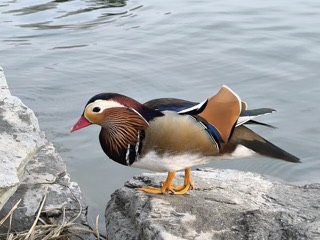 Mandarin Duck (reference photo)

Species Data
- Classification
- Anseriformes / Anatidae Source
- Size
- Males total length 48 cm / females 41 cm; wingspan 68–74 cm
- Weight
- Males about 0.6 kg / females about 0.5 kg
- Lifespan
- Wild: about 11 years / captive: about 15 years reported
- Diet
- Omnivore Omnivore with a strong plant bias; feeds on aquatic plants, fruit, seeds, insects, and land snails both on land and on the water surface
- Distribution
- Native to East Asia; introduced populations have also become established in Britain and elsewhere in Western Europe. Source
- Sources
- ja.wikipedia.org en.wikipedia.org
Did You Know?
- Mandarin ducks nest in tree cavities, and observations in the forest of the Imperial Palace in Tokyo have confirmed that newly hatched ducklings leap from the nest hole to the ground on their own. Source
- Mandarin ducks have 84 acrocentric chromosomes, compared to 80 in most other ducks, making hybridization with other species difficult. Source
Where to See This Species
Operating facilities registered on this site: Japan 20
Adventure WorldWakayamaOpened in 1978
Ishikawa DoubutsuenIshikawaAbout 60 minutes from the Kanazawa-Morimoto Interchange on the Hokuriku Expressway, about 40 minutes from the Kanazawa-Nishi Interchange, and about 20 minutes from the Komatsu Interchange.
MARINE WORLD uminonakamichiFukuokaFrom JR Hakata Station, take the Kagoshima Main Line 11 minutes to Kashii Station, transfer to the JR Kashii Line (bound for Saitozaki), and ride 20 minutes to Uminonakamichi Station.
Yokohama Shiritsu Nogeyama DoubutsuenKanagawaOpened in 1951
Osaka Aquarium KaiyukanOsakaOpened in 1990
Kyoto City ZooKyotoOpened in 1903
Kiryuugaoka DoubutsuenGunmaIf driving, set your car navigation to "Kiryugaoka Amusement Park" (Kiryugaoka Yuenchi) rather than "Kiryugaoka Zoo" to reach the parking lot (searching by the zoo name may give an incorrect route).
Noichi Zoological Park of Kochi PrefectureKochiA 20-minute walk or 13-minute rental-bicycle ride from Noichi Station on the Tosa Kuroshio Railway Gomen-Nahari Line.
Saitamakenkodomodoubutsu Shizen KouenSaitamaOpened in 1980
Sapporoshimaruyama DoubutsuenHokkaidoOpened in 1951
Hirakawa ZooKagoshimaAbout a 20-minute walk from Goino Station on the JR Ibusuki-Makurazaki Line, or take a bus bound for Taniyama / Dobutsuen from Fukuhira Nokyo-mae to the last stop.
Suzaka ZooNaganoFrom the Suzaka-Nagano-Higashi IC on the Joshin-etsu Expressway, take Route 403, turn right at the Kotaka-machi intersection, turn left at the Kami-Hatcho intersection, cross Garyu Bridge, and turn left for the south entrance.
Tennoji ZooOsakaOpened in 1915
TOBU ZOOSaitamaFrom Tobu-Dobutsu-Koen Station (west exit), about 10 minutes on foot (600 m) or about 5 minutes by bus.
Iida Shiritsu DoubutsuenNaganoAddress: 33 Ogimachi, Iida, Nagano.
Himeji Shiritsu DoubutsuenHyogoOpened in 1951
Hamamatsu Zoological GardensShizuokaOpened in 1950
Fukuoka Zoo & Botanical GardenFukuokaOpened in 1953
Higashiyama Zoo and Botanical GardensAichiOpened in 1937
Wakayamajou Kouen DoubutsuenWakayamaOpened in 1919
Conservation Story
Conservation Status
Least Concern (LC)
Sources
Support Conservation
A visit is a small, positive way to support the daily lives of the animals you care about.
- Visit
- A visit itself helps support the facility.
- Animal Supporter Programs & Giving
- Find ways to support the facility through its official website.
- Furusato Nozei
- Municipally run facilities may share official guidance for this Japanese hometown-tax program.
- Support Adventure World
- Support Ishikawa Doubutsuen
- Support MARINE WORLD uminonakamichi
- Support Yokohama Shiritsu Nogeyama Doubutsuen
- Support Osaka Aquarium Kaiyukan
- Support Kyoto City Zoo
- Support Kiryuugaoka Doubutsuen
- Support Noichi Zoological Park of Kochi Prefecture
- Support Saitamakenkodomodoubutsu Shizen Kouen
- Support Sapporoshimaruyama Doubutsuen
- Support Hirakawa Zoo
- Support Suzaka Zoo
- Support Tennoji Zoo
- Support TOBU ZOO
- Support Iida Shiritsu Doubutsuen
- Support Himeji Shiritsu Doubutsuen
- Support Hamamatsu Zoological Gardens
- Support Fukuoka Zoo & Botanical Garden
- Support Higashiyama Zoo and Botanical Gardens
- Support Wakayamajou Kouen Doubutsuen
FAQ
- Why is the mandarin duck a symbol of love in East Asia?
- In Chinese culture, mandarin ducks are called yuanyang and symbolize marital devotion, as they are traditionally believed to pair for life. Source
- How do mandarin duck chicks leave their nest?
- They nest in tree cavities, and chicks jump down to the ground on their own shortly after hatching—a behavior confirmed by observations in the forest of Japan's Imperial Palace. Source
- What do mandarin ducks eat?
- They are omnivorous, eating plant food such as beech mast and acorns as well as insects, small fish, frogs, and mollusks depending on the season. Source
- How many operating facilities are registered here?
- Operating facilities registered on this site: Japan 20 Source
Books & gear
Source: ja.wikipedia.org en.wikipedia.org